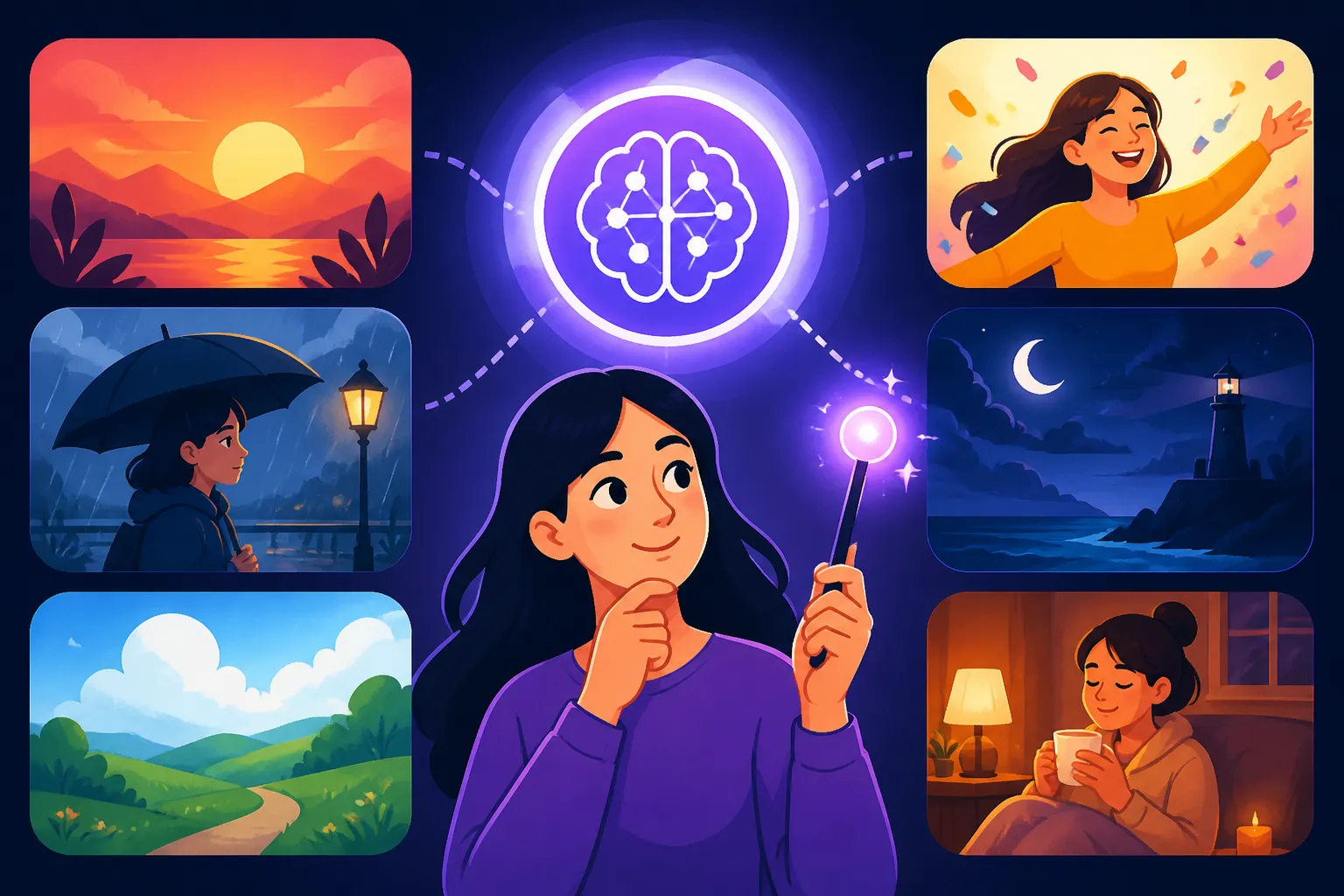
How to Prompt for Different Moods
We’ve all been there: you have a clear vision in your head—a scene that feels warm and inviting, or maybe one that’s steeped in mysterious shadows. You type in a few words to your favorite AI image generator, hit enter, and… the image is technically correct, but it’s flat, lifeless, missing that crucial emotional punch. The struggle to translate abstract feelings and atmospheres into concrete AI prompts is a common frustration for creators. This comprehensive guide will walk you through the nuances of prompting for different moods, helping you infuse your AI-generated images with the exact emotional resonance you envision.
The Art of Infusing Emotion into AI Images
Creating an image isn't just about depicting objects or scenes; it's about evoking a feeling, telling a story without words, and connecting with the viewer on a deeper level. When you're working with AI image generators, this becomes both a challenge and an incredible opportunity. The machine doesn't feel, but it can skillfully simulate feeling if you guide it properly.
Why Mood Matters in Visual Storytelling
Imagine a photograph of a lone tree on a hill. Depending on the lighting, the colors, and the atmospheric elements, that same tree can convey a vastly different narrative. Is it a beacon of hope against a sunrise? A stoic sentinel in a melancholic twilight? Or a spooky, gnarled figure under a stormy sky? The tree itself doesn't change, but the mood around it transforms its meaning entirely.
Mood is the emotional tone or atmosphere that an image conveys. It's the unspoken language that influences how a viewer perceives and reacts to your artwork. In visual storytelling, mood sets the context, deepens character, and drives narrative without a single line of dialogue. For a blogger, a marketer, or an artist, getting the mood right can mean the difference between an image that's scrolled past and one that truly captivates. It helps establish brand identity, communicate complex ideas quickly, and even manipulate viewer perception. If you're trying to sell a cozy blanket, a picture with a bright, harsh mood won't do it justice. You need warmth, softness, and inviting tones.
How AI Interprets Emotional Cues
It's tempting to think of AI as a magic box that inherently understands what "sad" or "happy" means. In reality, AI models like Midjourney, DALL-E, or Stable Diffusion don't possess human emotions. Instead, they are trained on truly massive datasets of images and their corresponding text descriptions. Through this process, they learn to associate certain visual elements with specific descriptive words. When you prompt for "melancholic forest," the AI doesn't feel melancholy. Instead, it accesses its vast internal database, identifying patterns and features commonly present in images previously tagged as "melancholic" — perhaps muted colors, soft light, falling leaves, or a solitary figure.
Think of it like a highly sophisticated pattern-matching engine. If you tell it "serene," it recalls countless instances of tranquil landscapes, calm waters, soft natural light, and quiet compositions. If you ask for "energetic," it might lean towards dynamic angles, vibrant colors, motion blur, and active subjects. Your job, as the prompt engineer, is to supply the AI with enough of these learned associations to accurately reconstruct the desired mood. This often means going beyond a single adjective and delving into the specific visual ingredients that contribute to that feeling.
Deconstructing the Elements of Mood in Your Prompts
To effectively guide your AI, you need to break down "mood" into its constituent visual elements. Each component of your prompt—from the colors you choose to the way light falls on your subject—plays a critical role in shaping the emotional landscape of your generated image.
The Power of Color and Lighting
These two elements are arguably the most potent mood setters in any visual art. They speak directly to our subconscious and evoke immediate emotional responses.
Color Palettes and Their Emotional Impact
Color is a fundamental emotional trigger. Different colors and color combinations have universally recognized psychological effects, though cultural interpretations can sometimes vary.
- Warm Colors (Reds, Oranges, Yellows): These colors are often associated with energy, passion, excitement, warmth, and even aggression. A vibrant red can scream urgency or love, while a soft orange might suggest a cozy sunset or autumn comfort. Use them when you want to create a feeling of dynamism, coziness, or intense emotion. For instance, a "fiery orange and deep red cityscape at dusk" will inherently feel more dramatic than one in cool tones.
- Cool Colors (Blues, Greens, Purples): These hues tend to evoke calmness, serenity, sadness, mystery, or sophistication. Light blues can be tranquil, while deep blues might feel melancholic or mysterious. Greens often signify nature, growth, or harmony, but also envy. Purples can suggest royalty, magic, or introspection. A "misty forest in shades of deep blue and emerald green" will instantly feel more serene or enigmatic.
- Neutral Colors (Grays, Browns, Beiges): These colors are excellent for grounding an image, adding sophistication, or creating a subdued, realistic mood. They can also contribute to feelings of melancholy or quiet contemplation, especially when desaturated.
- Saturation: Highly saturated colors often convey intensity, vibrancy, and excitement. Desaturated or muted colors can evoke feelings of nostalgia, melancholy, realism, or a dreamlike quality. Think of the difference between a bright, cartoonish scene and a faded, vintage photograph.
Manipulating Light to Set the Scene
Lighting is not just about illumination; it's about shaping form, revealing texture, creating drama, and, most importantly, dictating mood. The quality, direction, and intensity of light profoundly influence how we perceive a scene.
- Soft vs. Harsh Lighting: Soft, diffused light (like on a cloudy day or from a large studio softbox) tends to create a gentle, flattering, and often peaceful mood with subtle shadows. Harsh, direct light (like midday sun or a spotlight) produces strong contrasts, sharp shadows, and can convey drama, intensity, or even an unsettling atmosphere.
- Time of Day:
- Golden Hour: The hour after sunrise and before sunset, characterized by soft, warm, golden light. It's universally loved for its ability to create magical, romantic, and nostalgic moods.
- Blue Hour: The period just after sunset or before sunrise, when the sky turns a deep, rich blue. It's excellent for evoking mystery, serenity, or a sense of quiet anticipation.
- Midday Sun: Often harsh and bright, creating strong, overhead shadows. Can convey realism, starkness, or a sense of bustling activity if used correctly, but also a lack of subtlety.
- Twilight/Night: Deep shadows, artificial light sources (streetlights, neon, moonlight). Perfect for mystery, drama, romance, or solitude.
- Light Sources and Effects:
- Candlelight: Warm, flickering, intimate, ancient, romantic.
- Neon Lights: Modern, vibrant, urban, energetic, futuristic, sometimes gritty.
- Firelight: Cozy, primal, warm, dangerous, dramatic.
- Window Light: Natural, soft, can highlight a subject thoughtfully.
- Backlighting: Creates silhouettes, adds drama, highlights edges, can be ethereal or mysterious.
- Volumetric Lighting/God Rays: Light shafts through dust or fog, adds epic, spiritual, or dramatic flair.
- Shadows: Just as important as light. Long shadows, deep shadows, dappled shadows—all contribute significantly to mood.
For example, comparing "a bustling market, bright sun, vibrant colors" with "a bustling market, rainy evening, warm glow of lanterns" shows how lighting alone shifts the entire emotional experience from energetic and lively to cozy and nostalgic. When How to Add Lighting to AI Prompts is mastered, your control over mood will skyrocket.
Composition, Subject, and Setting as Mood Modifiers
Beyond color and light, the arrangement of elements within your image, what you choose to feature, and where it all takes place are powerful levers for mood generation.
Strategic Composition and Framing
Composition refers to the arrangement of visual elements within the frame. It guides the viewer's eye and influences their emotional response.
- Open vs. Closed Compositions: An open composition feels expansive, inviting the viewer's eye to move beyond the frame, often conveying a sense of freedom or endless possibility. A closed composition, where all elements are contained within the frame, can feel intimate, focused, or sometimes claustrophobic depending on the subject matter.
- Dynamic vs. Static Compositions: Dynamic compositions use diagonal lines, strong angles, and implied motion to create energy, excitement, or tension. Static compositions, relying on horizontal and vertical lines, often convey stability, calmness, or stillness.
- Leading Lines: Using paths, fences, or rivers to draw the eye towards a focal point can create a sense of journey, anticipation, or purpose.
- Negative Space: The empty space around and between the subject(s) of an image. Abundant negative space can convey solitude, peace, or importance to the subject. Lack of negative space can feel chaotic or overwhelming.
A wide-angle shot of a character standing alone on a vast plain with a low horizon line will evoke solitude and perhaps contemplation. In contrast, a close-up, Dutch-angle shot of a character's intense face in a crowded scene will convey tension or urgency. Consider exploring How to Control Composition in Prompts for even more mastery.
The Subject's Emotional Resonance
The main subject of your image inherently carries emotional weight, but how you describe it to the AI can amplify or alter that mood.
- Expression and Posture: For human or animal subjects, explicit descriptions of facial expressions (e.g., "pensive gaze," "joyful smile," "furrowed brow") and body language (e.g., "slumped shoulders," "arms outstretched," "crouching defensively") are paramount.
- Interaction: How subjects interact with their environment or with other subjects. A group celebrating vs. a lone figure gazing out a window.
- Inherent Qualities: A gentle stream naturally suggests calm, while a roaring waterfall implies power and chaos. A child playing evokes innocence and joy, whereas an ancient, gnarled tree can suggest wisdom or mystery.
Describing "a child laughing, jumping through sprinklers" is clearly joyful, but "a child sitting by a window, watching rain fall, with a thoughtful expression" shifts to a more reflective, perhaps melancholic, mood.
Setting the Scene with Environment and Atmosphere
The environment where your image takes place provides the backdrop for the mood. Specific details about the setting can ground the emotion.
- Environment Types:
- Urban: Bustling city streets (energetic, chaotic), quiet alleyways (mysterious, gritty), modern skyscrapers (futuristic, imposing).
- Natural: Serene forests (peaceful, ancient), stormy seas (powerful, dangerous), sun-drenched beaches (relaxing, happy).
- Interior: Cozy cafes (warm, inviting), dimly lit libraries (introspective, mysterious), grand ballrooms (elegant, celebratory).
- Weather and Atmospheric Effects:
- Rain: Melancholy, dramatic, refreshing, cozy (if indoors).
- Fog/Mist: Mystery, eeriness, serenity, dreamlike.
- Snow: Quiet, magical, cold, isolated.
- Sunlight: Happiness, warmth, energy, optimism.
- Wind: Dynamic, wild, desolate, refreshing.
"An abandoned mansion in a misty, overgrown forest at twilight" creates a vastly different mood than "a brightly lit, bustling market in a vibrant Mediterranean town."
Artistic Styles and Textures
The artistic style and specific textures you request can embed a foundational mood even before other elements are considered. Certain styles intrinsically lean towards particular emotional landscapes.
Styles as Emotional Frameworks
- Photorealistic: Often conveys immediate reality, authenticity, or a stark, unfiltered emotion. If your goal is high impact or a sense of "this could be real," photorealism is key.
- Impressionistic: Evokes a dreamlike quality, softness, nostalgia, or fleeting moments. The blurred edges and focus on light and color over sharp detail lend themselves to softer, more contemplative moods.
- Cyberpunk: Future-focused, gritty, often dark, technologically advanced but socially decaying. It naturally creates moods of intrigue, oppression, or rebellious energy.
- Watercolor: Light, ethereal, gentle, often associated with tranquility, softness, or a whimsical touch.
- Cinematic: Dramatic, epic, grand, often evokes a sense of story, high stakes, or powerful emotions due to its association with film. This style inherently has a strong, often intense, mood. Learning How to Prompt for a Cinematic Look is incredibly valuable.
- Abstract: Can convey confusion, raw emotion, freedom, or introspection, depending on the forms and colors used.
- Minimalist: Clean, calm, sophisticated, often evokes a sense of peace or starkness.
When you specify "a bustling city street, cyberpunk style, neon glow," you're not just describing a place; you're imbuing it with a specific future-noir mood.
Adding Depth with Textures and Fine Details
Small details, textures, and atmospheric effects can add layers of mood and realism.
- Surface Textures: Describing materials like "rough concrete," "smooth marble," "weathered wood," or "velvet upholstery" can ground the image in a tactile reality that reinforces mood. Rough textures might add grittiness or age, while smooth textures can suggest luxury or coldness.
- Atmospheric Particulates: "Dust motes floating in sunlight," "falling cherry blossoms," "wind-blown leaves," "rain streaks on a windowpane" all contribute to a vivid, palpable atmosphere.
- Lens Effects: "Shallow depth of field," "bokeh background," "lens flare," "vignette" can add a professional, artistic, or nostalgic feel. A shallow depth of field, for example, isolates the subject, often enhancing a feeling of focus or solitude.
- Grain/Noise: Adding film grain or digital noise can evoke a vintage, gritty, or raw aesthetic.
Consider the prompt "a lonely figure walking through a deserted alley, rain streaks on pavement, reflections in puddles, cinematic lighting, film noir style." The textures (rain streaks, pavement reflections) and specific lighting contribute immensely to the melancholic and mysterious mood.
Crafting Prompts for Common Emotional Tones
Now that we've broken down the elements, let's put them together to craft prompts for specific, commonly desired moods. The key is to combine several of these elements into a cohesive description.
Evoking Serenity and Calmness
When aiming for a serene and calm mood, think about elements that promote peace, quiet, and a sense of ease.
- Keywords to consider: peaceful, tranquil, quiet, serene, calm, gentle, soft, ethereal, misty, harmonious, still, reflective, meditative, spacious, expansive.
- Color/Lighting: Soft pastels, cool blues and greens, muted tones, diffused light, early morning light, twilight, golden hour (subdued), overcast sky, gentle glow, subtle shadows.
- Composition/Subject: Open compositions, horizons, solitary figures (contemplative), calm water, smooth textures, symmetrical elements, distant views, nature scenes (forests, lakes, meadows), soft focus.
- Atmosphere: Gentle breeze, mist, dew, falling petals, quiet snowfall.
Example Prompts:
- "A lone meditator sits by a still lake at dawn, surrounded by misty mountains, soft pastel hues, ethereal glow, tranquil, harmonious, expansive landscape, cinematic, detailed, photorealistic."
- "A cozy reading nook bathed in soft window light, gentle diffused illumination, steaming mug, a half-read book, warm wooden textures, peaceful, serene, inviting atmosphere, shallow depth of field."
- "A Japanese garden, zen aesthetic, smooth raked gravel, moss-covered stones, gentle ripple in a pond, soft morning light, tranquil, minimalist, high detail."
Generating Energy and Excitement
To inject energy and excitement into your images, you'll want to use elements that suggest movement, vibrancy, and a dynamic atmosphere.
- Keywords to consider: energetic, vibrant, dynamic, exhilarating, thrilling, bustling, lively, explosive, fast-paced, intense, electric, dramatic.
- Color/Lighting: Bright, highly saturated colors, strong contrasts, neon lights, flashes of light, high key lighting, strong sunlight, lens flares, motion blur, dramatic shadows.
- Composition/Subject: Diagonal lines, busy scenes, crowds, active figures, action shots, implied motion, low or high camera angles, close-ups showing intensity, asymmetric compositions.
- Atmosphere: Smoke, steam, rain, confetti, sparks, dust, cheering crowds.
Example Prompts:
- "A rock concert, lead singer jumping mid-air, stage lights blazing, intense reds and blues, crowd cheering, motion blur, dynamic composition, energetic, electric atmosphere, gritty texture, high-contrast, wide-angle shot."
- "A bustling Tokyo street at night, neon signs blazing, reflections on wet pavement, fast-moving traffic with light trails, energetic, vibrant, futuristic, long exposure photography style."
- "Explosion of colorful holi powder against a bright blue sky, joyous celebration, dynamic action shot, vibrant, high-energy, high-speed photography."
Creating Mystery and Intrigue
For a sense of mystery and intrigue, focus on what's hidden, partially revealed, or ambiguous. Embrace shadows and subtle hints.
- Keywords to consider: mysterious, enigmatic, shadowy, hidden, ominous, suspenseful, eerie, clandestine, ancient, intriguing, twilight, foreboding.
- Color/Lighting: Low key lighting, deep shadows, silhouettes, limited color palette, desaturated colors, cool tones (deep blues, purples), flickering lights, mist, fog, moonlight, backlighting, chiaroscuro.
- Composition/Subject: Obscured faces, figures partially hidden, narrow corridors, winding paths, abandoned places, cryptic symbols, unexpected juxtapositions, leading lines into darkness, solitary figures facing away.
- Atmosphere: Thick fog, rain, dust motes, strange glows, distant sounds (implied).
Example Prompts:
- "A cloaked figure stands at the entrance of a hidden ancient ruin, overgrown with vines, deep shadows, shafts of moonlight filtering through, mysterious, eerie, foreboding atmosphere, cinematic, high detail, volumetric lighting."
- "A detective's office at 3 AM, rain streaks on the window, a single lamp casts long shadows, smoke curling from an ashtray, enigmatic, film noir style, grainy texture, low key lighting."
- "An old, forgotten library, shelves disappearing into the shadows, a single dust-covered book glowing faintly, mysterious light source, silent, ancient, unsettling, dark academia aesthetic."
Expressing Melancholy and Reflection
Melancholy is a gentle sadness, often mixed with contemplation or wistfulness. It's not despair but a quiet, pensive mood.
- Keywords to consider: melancholic, wistful, somber, pensive, reflective, solitary, nostalgic, quiet, subdued, yearning, faded, forgotten, solemn.
- Color/Lighting: Muted, desaturated colors, cool grays and blues, soft, diffused light, overcast skies, gentle rain, twilight, monochrome, low contrast.
- Composition/Subject: Solitary figures, empty spaces, fallen leaves, weathered objects, reflections, people looking out windows, old photographs, downward gazes, soft focus.
- Atmosphere: Gentle rain, mist, autumn leaves, faded sunlight.
Example Prompts:
- "A person sitting alone on a park bench, back to the viewer, under an overcast sky, gentle rain falling, reflections on wet pavement, muted blues and grays, pensive, melancholic, shallow depth of field, subtle film grain."
- "An old, forgotten swing set in a overgrown field at twilight, overgrown weeds, soft, muted colors, nostalgic, wistful, serene, cinematic lighting, a touch of mist."
- "A close-up of a single tear rolling down a face, softly lit by a window, chiaroscuro, subtle shadows, somber, reflective, photorealistic, with slight imperfections."
Infusing Joy and Warmth
For moods of joy and warmth, think about elements that bring comfort, happiness, celebration, and brightness.
- Keywords to consider: joyful, warm, cheerful, vibrant, festive, cozy, comforting, inviting, blissful, radiant, playful, optimistic.
- Color/Lighting: Bright, warm, saturated colors (yellows, oranges, soft reds), golden hour light, dappled sunlight, soft ambient lighting, twinkling lights, high key lighting, gentle lens flares.
- Composition/Subject: Smiling faces, groups laughing, vibrant flowers, cozy interiors, warm beverages, playful animals, open and bright spaces, celebrations, sunny landscapes.
- Atmosphere: Sunlight, soft glow, laughter (implied), sparkling elements, gentle breezes.
Example Prompts:
- "A family gathered around a fireplace, warm glowing embers, soft ambient light illuminating happy faces, cozy, inviting atmosphere, rich wooden textures, joyful, golden hour indoors, photorealistic."
- "A child running through a field of sunflowers under a bright, sunny sky, arms outstretched, vibrant yellows and greens, joyful, carefree, playful, dynamic, shallow depth of field."
- "A brightly lit outdoor cafe in a bustling European city, people laughing, steam rising from coffee cups, vibrant flowers on tables, warm, inviting, cheerful, golden hour."
| Mood Category | Key Colors & Lighting | Composition & Subject | Keywords & Descriptors |
|---|---|---|---|
| Serenity | Cool blues, pastels, diffused light | Open spaces, calm water, solitary figures | Peaceful, tranquil, quiet, gentle, ethereal, still |
| Energy | Bright, saturated, neon, high-contrast | Dynamic lines, action, crowds, motion blur | Vibrant, dynamic, exhilarating, bustling, intense |
| Mystery | Low-key, deep shadows, cool tones, fog | Obscured subjects, narrow paths, silhouettes | Enigmatic, shadowy, ominous, suspenseful, eerie |
| Melancholy | Muted, desaturated, cool grays, rain | Solitary, empty spaces, pensive figures | Wistful, somber, reflective, quiet, subdued |
| Joy/Warmth | Bright, warm, saturated, golden hour | Smiling faces, celebrations, cozy scenes | Cheerful, vibrant, cozy, comforting, blissful |
Advanced Techniques for Nuanced Mood Control
Once you've grasped the basics of single-mood prompting, it's time to explore how to achieve more complex and nuanced emotional tones. AI image generation truly shines when you start blending, subtracting, and refining your prompts.
Combining Moods and Juxtaposition
Sometimes, a single mood isn't enough to capture the richness of your vision. What if you want to convey a "tranquil chaos" or a "nostalgic future"? This is where combining moods and using juxtaposition comes in.
To blend moods, you can simply include keywords from different emotional categories in the same prompt. The AI will try to find visual elements that represent both. For example, "a serene cityscape at rush hour, golden hour, people moving in a blur, calm reflections in puddles, peaceful chaos." Here, "serene," "calm," and "peaceful" clash with "rush hour" and "chaos," resulting in a unique mood.
Another powerful technique is juxtaposition, placing contrasting elements side-by-side to create a new emotional impact. This can be done with:
- Subject Juxtaposition: A playful puppy in a desolate, industrial wasteland might evoke a sense of innocence lost or unexpected hope.
- Color/Lighting Juxtaposition: A single warm light in an otherwise cold, blue scene can highlight a focal point of comfort or danger.
- Setting Juxtaposition: An ancient ruin meticulously maintained within a futuristic city.
Many AI tools, like Midjourney, allow you to use "weights" (e.g., word::2) to give certain parts of your prompt more emphasis. This is incredibly useful when blending moods, letting you specify which emotion should dominate or merely be a subtle undercurrent. For a deeper dive into combining elements, check out resources like How to Use Multi-Prompts in Midjourney.
Utilizing Negative Prompts and Parameters
Sometimes, achieving the right mood isn't just about adding elements, but about removing unwanted ones. This is where negative prompts become invaluable.
A negative prompt tells the AI what not to include in the image. If you're trying to achieve a peaceful scene but keep getting overly gloomy results, you might add a negative prompt like --no gloomy, sad, dark contrast. This instructs the AI to actively avoid those visual characteristics, pushing it towards a more serene outcome. Similarly, if your "energetic" scene is looking too static, you might try --no still, quiet, calm. Understanding How to Use Negative Prompts can dramatically improve your results.
Beyond negative prompts, many AI image generators offer parameters or settings that can influence the overall aesthetic and, by extension, the mood.
- Stylize (e.g., Midjourney's
--sparameter): This can control how artistic or opinionated the AI's rendering is. A low stylize might give you a more literal, less emotional image, while a higher stylize can infuse more artistic flair, often leading to stronger moods (though sometimes less control). - CFG Scale (e.g., Stable Diffusion): Classifier Free Guidance scale dictates how strongly the AI follows your prompt versus its own artistic interpretation. A higher CFG scale usually means it sticks closer to your prompt, which can be useful when you have a very specific mood in mind and want to avoid the AI's "default" emotional leanings.
- Aspect Ratios: The ratio of width to height can also subtly affect mood. A wide, cinematic aspect ratio (like 16:9 or 21:9) can feel more epic or dramatic, while a square ratio (1:1) might feel more balanced or intimate.
Experimenting with these parameters alongside your descriptive prompts is crucial for fine-tuning the emotional output.
Iteration and Refinement for Perfecting Mood
Rarely will your first prompt perfectly capture the exact mood you're aiming for. AI image generation is an iterative process, much like traditional art or writing. The key is to start broad and then gradually refine.
- Start with the Core Idea: Begin with the main subject and a primary mood adjective. "Forest, melancholic."
- Add Key Elements: Layer in major mood influencers: "Forest, melancholic, twilight, mist, cool colors."
- Introduce Specific Details: Bring in the textures, lighting effects, and atmospheric elements: "Forest, melancholic, twilight, mist, cool blues and grays, soft rain, wet foliage, solitary figure in the distance."
- Refine with Negative Prompts and Parameters: If it's too bright, add
--no bright, sunny. If it's too realistic and you want something dreamier, adjust stylize or add a style keyword.
Each generation gives you feedback. Analyze what worked, what didn't, and what deviated from your vision. Then, make small, targeted adjustments to your prompt and try again. Sometimes, changing a single word—from "dark" to "shadowy," or "gentle" to "ethereal"—can make a world of difference. Don't be afraid to generate many variations. Learning How to Get Better AI Image Results and How to Iterate on AI Image Prompts are fundamental skills.
Overcoming Challenges in Mood Generation
Even with a strong understanding of prompt engineering, you'll inevitably face hurdles when trying to elicit precise emotions from your AI tools. It's like trying to explain a dream to someone who's never dreamed before—you need to be incredibly descriptive and specific.
Avoiding Generic or Flat Emotions
One of the biggest pitfalls is relying on overly simplistic or generic emotional keywords. Just saying "sad city" might give you a city scene with rain, but it might lack the nuanced, specific type of sadness you're imagining—is it a bustling city with a single melancholic figure, or a completely desolate cityscape echoing with emptiness?
- Use Rich, Descriptive Language: Instead of "happy," try "joyful, effervescent, exuberant, blissful." Instead of "scary," opt for "eerie, unsettling, foreboding, terrifying, suspenseful." The more evocative your adjectives, the better the AI can grasp the specific flavor of emotion. Think in terms of synonyms and specific nuances.
- Incorporate Sensory Details: Describe what the mood feels like, sounds like, or tastes like (metaphorically). "The scent of old books and dust" adds to a nostalgic or mysterious mood. "The crisp bite of autumn air" grounds a reflective scene.
- Leverage Metaphors and Analogies: While AI doesn't understand metaphors in the human sense, phrasing like "a silence that hums with anticipation" or "colors bleeding like a bruised sky" can provide the AI with stronger visual cues to pull from its training data. These rich descriptions act as multiple individual keywords the AI can process.
- Focus on the Effect of the Mood: Instead of just "calm," describe how it's calm: "a pervasive calm that stills the air" or "a calm so profound it feels eternal." This pushes the AI towards more profound visual representations.
Remember, the AI is a pattern-matching machine. The more unique, vivid, and detailed patterns you can provide for your desired mood, the less generic your results will be. It's not just about what to include, but how to write your AI prompts effectively. For a foundational approach, revisit How to Write AI Image Prompts and AI Image Prompt Guide for Beginners.
The Role of Specificity and Ambiguity
Striking the right balance between being overly specific and too ambiguous is key.
- When to be Specific: If you have a precise visual in mind for your mood, be as detailed as possible. For instance, if you want a "dramatic" scene, don't just say "dramatic." Instead, describe the components of that drama: "dramatic chiaroscuro lighting, deep shadows, a single spotlight on a figure, high contrast, cinematic atmosphere." When you want to control every aspect of the mood, specific keywords are your best friend. This ensures the AI doesn't wander off into its own interpretations.
- When to Allow Ambiguity (Carefully): Sometimes, a slight degree of ambiguity can allow the AI to introduce surprising and delightful elements you hadn't considered, adding depth to the mood. For instance, if you want a "dreamlike forest," you might use fewer explicit details about tree types or light sources, letting the AI generate something truly surreal. However, this is a more advanced technique and requires a good understanding of how your chosen AI model tends to interpret vagueness. Too much ambiguity and you risk getting generic or unrelated results. The trick is to be ambiguously intentional, setting a mood without dictating every single object.
The goal isn't just to get an image; it's to get an image that resonates emotionally. This often involves a dance between precise instructions for core elements and enough room for the AI to creatively interpret the nuanced feelings you're trying to convey.
Leveraging Reference Images and Style Guides
Even if your AI tool doesn't directly support image-to-image prompting, reference images are incredibly valuable for you as the prompt writer.
- Visualizing the Mood: Before you type a single word, browse art, photography, or even film stills that capture the mood you're after. Notice the color palette, the lighting, the composition, the expressions. This helps you build a mental "mood board" that you can then translate into textual prompts. For example, if you want a "gritty, cyberpunk mood," look at stills from Blade Runner or Ghost in the Shell and extract visual keywords like "neon glow, rain-slicked streets, towering skyscrapers, low light, steam, reflective surfaces."
- Extracting Keywords: As you look at reference images, consciously pull out descriptive words. What kind of light is it? What colors dominate? Are there strong shadows? What's the overall feeling? These words become the building blocks of your prompt.
- Maintaining Consistency: If you're creating a series of images for a project (e.g., a blog post, social media campaign), using a consistent set of mood-related keywords and a common "style guide" (even if just a mental one) can ensure visual and emotional coherence across all your generations.
Understanding How to Use Reference Images in Prompts isn't just about direct input; it's about training your own eye to see and articulate the components of mood effectively. This external research helps you bridge the gap between abstract emotion and concrete descriptive language that your AI understands.
Disclaimer
The information provided in this article is for general informational purposes only and does not constitute professional advice. AI image generation technology is constantly evolving, and the effectiveness of prompts may vary depending on the specific AI model, version, and parameters used. Always review the terms of service and usage rights for any AI tool you use, especially for commercial purposes.