Best AI Tool for Icons in 2027
Trying to find the perfect icons for your website, app, or marketing materials can feel like searching for a needle in a haystack. You either spend hours sifting through stock libraries only to find generic designs everyone else is using, or you face the daunting task of creating them from scratch, which requires a designer's touch and often a hefty budget. This guide is here to cut through that frustration, revealing the best AI tools available that can help you generate unique, high-quality icons quickly and efficiently, even if you’ve never touched a design program before.
The Challenge of Icon Design in Today's Digital World
It's a common dilemma: you've got a fantastic idea for a new product, a fresh website redesign, or an engaging social media campaign. Everything is coming together, but then you hit the icon wall. Those tiny visual cues are so crucial for user experience, branding, and conveying information at a glance. But getting them right, especially with limited resources, often feels like an uphill battle.
Why Generic Icons Just Don't Cut It Anymore
In an increasingly crowded digital landscape, standing out is paramount. Using the same old, tired icon sets from a free library can make your brand feel uninspired and, frankly, a bit cheap. Imagine launching a cutting-edge tech startup only to use icons that look like they belong in a Windows 95 interface. It instantly undermines your credibility. Users today expect a seamless, aesthetically pleasing experience, and custom icons are a significant part of that. They reflect your brand's unique personality and help create a memorable visual identity. When every other competitor is pulling from the same well of bland graphics, a distinctive icon set can be your secret weapon. For instance, if you're building a niche app for urban gardeners, generic leaf icons won't resonate as much as a stylized trowel or a tiny, vibrant tomato plant illustration.
The Time and Cost Drain of Traditional Iconography
Hiring a professional graphic designer to create a custom icon set can be prohibitively expensive, especially for startups, small businesses, or independent creators. We're talking hundreds, sometimes thousands, of dollars for a comprehensive package. And then there's the time factor. Briefing a designer, waiting for initial concepts, going through rounds of revisions – it can stretch out for weeks, delaying your project timelines. Even if you try to design them yourself using tools like Adobe Illustrator, the learning curve is steep, and achieving a polished, consistent look requires a considerable investment of time and skill. This is where the promise of AI truly shines, offering a viable, cost-effective, and remarkably fast alternative that puts professional-grade icon creation within reach for everyone.
Key Features to Look for in an AI Icon Generator
Not all AI image generators are created equal, especially when it comes to the specific needs of icon design. While some excel at photorealistic landscapes or complex character art, what makes an AI tool truly shine for icons are specific functionalities that ensure usability, quality, and versatility.
Vector Output and Scalability
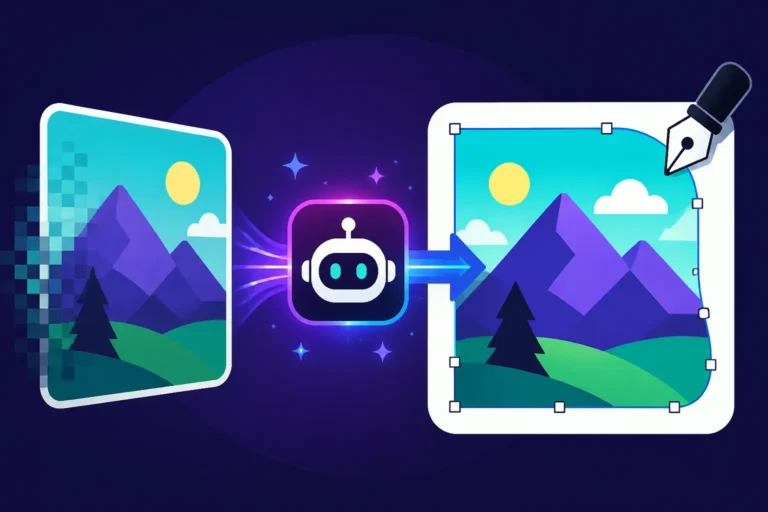
This is arguably the most crucial feature for any icon generator. Icons are rarely used at a single fixed size. They need to look sharp and crisp whether they're a tiny favicon in a browser tab or blown up to billboard size for a presentation. This is where vector graphics come into play. Unlike raster images (like JPEGs or PNGs) that pixelate when scaled, vector graphics are based on mathematical paths, allowing them to be scaled infinitely without any loss of quality. Look for AI tools that can directly output in SVG (Scalable Vector Graphics) format or offer easy conversion options. Tools like Recraft SVG and Logo Review are specifically designed with vector art in mind. Without vector output, your "icons" will quickly become blurry messes the moment you try to use them at different resolutions, rendering them practically useless for professional application.
Style Consistency and Customization
A cohesive set of icons is essential for a professional look. Imagine a website where one icon is minimalist line art, another is a colorful 3D render, and a third looks like a hand-drawn sketch – it would be a visual mess and incredibly jarring for the user. The best AI icon generators allow you to maintain a consistent style across all your creations. This means features that let you define specific aesthetic parameters, reuse style prompts, or even train the AI on a particular visual language. Furthermore, the ability to customize existing designs – tweaking colors, shapes, or details – is vital. You don't just want a one-and-done image; you need the flexibility to adapt it to your brand's precise requirements. Being able to easily modify stroke weights, fill colors, or corner radii after generation can make all the difference in achieving that perfect, branded look.
Ease of Use and Workflow Integration
Let's be honest, if a tool is too complex, we won't use it. For AI icon generation, ease of use is key, especially for those without a design background. A user-friendly interface, intuitive prompting mechanisms, and straightforward export options are non-negotiable. The ideal tool should allow you to go from concept to finished icon with minimal friction. Beyond just generating the image, consider how well the tool integrates into your existing workflow. Can you easily import your creations into design software like Adobe XD, Figma, or Canva? Does it offer batch generation for creating multiple variations quickly? For beginners, a platform that simplifies the process of creating high-quality icons, such as those discussed in Best AI Image Generator for Ease of Use, will be invaluable. The goal is to reduce the cognitive load, not add to it, so you can focus on your project rather than wrestling with complicated software.
Top AI Tools for Icon Generation
The landscape of AI image generation is constantly evolving, but certain tools have emerged as frontrunners for icon creation due to their specialized capabilities and user-friendly interfaces.
Ideal Tools for Vector Icons and Logos
When it comes to generating icons that are truly scalable and ready for professional use, vector-focused AI tools are a game-changer. These platforms understand the nuances of creating sharp lines, clean shapes, and mathematically precise graphics.
One of the standout options in this category is Recraft. Recraft is purpose-built for creating vector art, illustrations, and logos, making it an incredibly powerful tool for icon design. Instead of generating raster images and then attempting to vectorize them (which can often lead to messy results), Recraft works directly in a vector-native environment. You can prompt it for various icon styles – from sleek, minimalist line art to intricate, colorful emblems – and it reliably outputs SVG files. This is invaluable for designers and marketers who need assets that can be scaled from a tiny app icon to a large banner without losing any fidelity. For anyone interested in a deeper dive, our Recraft Review for Vector Art explores its capabilities in detail. Another strong contender that often gets overlooked but offers impressive vector capabilities through its various models is Stable Diffusion. While it requires a bit more technical know-how or a user-friendly wrapper, it can be fine-tuned to produce excellent scalable graphics. The community around Stable Diffusion often shares specific models and workflows optimized for vector-like outputs, and its open-source nature means continuous innovation in this space.
Best for Stylized and Thematic Icons
Sometimes, you need icons with a very specific artistic flair or a distinct theme to match your brand's aesthetic. This is where AI tools that excel in diverse artistic styles really shine.
Ideogram is quickly gaining recognition for its ability to handle text within images, but it's also incredibly versatile for stylized icons. Its strength lies in generating images with a specific mood, color palette, or artistic style, making it fantastic for creating thematic icon sets. For example, if you need a set of icons for a medieval fantasy game, you could prompt Ideogram to create "a stylized shield icon, ornate, dark fantasy, gold and crimson, distressed texture, flat design." The results often have a consistent artistic touch that's difficult to achieve with more general-purpose tools. Similarly, Midjourney is a powerhouse for unique artistic expressions. While it primarily generates raster images, its unparalleled ability to interpret complex artistic prompts and produce stunning, high-quality visuals can be leveraged for highly stylized icons. You can guide Midjourney to create icons in a specific artistic style – think "steampunk robot icon," "art nouveau flower icon," or "pixel art spaceship icon" – and then use a separate vectorization tool (if SVG is required) to convert the raster output. For inspiration on crafting artistic prompts, check out our guide on How to Write AI Prompts for Pixel Art Images. This two-step process, while slightly more involved, allows for an incredible range of creative freedom, making Midjourney an excellent choice for those seeking truly distinctive icon visuals.
User-Friendly Options for Beginners
Not everyone needs or wants to delve into complex prompting or vector conversion. For many users, simplicity and immediate results are paramount. Thankfully, several AI tools are designed with beginners in mind, making icon creation accessible to everyone.
Canva AI Image Generator is a fantastic starting point for anyone new to AI image creation. If you're already familiar with Canva for other design tasks, integrating AI icon generation feels natural. You simply enter a text prompt, and Canva will generate various image options. While it typically produces raster images, it's incredibly fast and convenient for creating simple, visually appealing icons for presentations, social media graphics, or blog posts. The strength of Canva lies in its entire ecosystem, allowing you to immediately drop your AI-generated icons into existing designs. For an overview of its capabilities, consider reading our Canva AI Image Generator Review. Another excellent choice for beginners is Bing Image Creator, powered by DALL-E. It's completely free to use, integrated directly into Microsoft's ecosystem, and incredibly straightforward. You type in what you want, and it generates a selection of images. While its control over specific artistic styles might be less granular than Midjourney or Ideogram, it's perfect for generating quick, functional icons without any fuss or subscription fees. For instance, prompting "a simple gear icon, flat design, blue and white" often yields immediate and usable results. These tools remove the barriers to entry, allowing individuals to experiment and generate custom icons without needing any prior design experience or investing in expensive software.
Crafting Perfect Icon Prompts for AI
The quality of your AI-generated icons hinges almost entirely on the quality of your prompts. It's not just about telling the AI what you want, but how you want it, in what style, and with what characteristics. Mastering the art of prompt engineering for icons will unlock their full potential.
Deconstructing Effective Icon Prompts
Think of an effective icon prompt as a recipe. Each ingredient plays a crucial role in the final dish. For icons, these ingredients typically include:
- The Subject: What is the icon representing? (e.g., "a camera," "a cloud," "a magnifying glass")
- The Style: What artistic look are you aiming for? (e.g., "flat design," "line art," "3D render," "material design," "neumorphism," "pixel art")
- Key Attributes/Details: Specific characteristics that define the icon. (e.g., "minimalist," "geometric," "hand-drawn," "glossy," "gradient," "shadowed," "round corners")
- Color Palette: Optional, but very powerful. (e.g., "blue and white," "vibrant pastels," "monochromatic green")
- Context/Purpose (Optional but helpful): Sometimes, adding where it will be used can guide the AI. (e.g., "app icon," "website button icon")
Let's take an example: Instead of just "camera icon," try:
"A minimalist camera icon, flat design, geometric shapes, vibrant orange and white, app icon aesthetic."
This structured approach gives the AI much more to work with, moving it away from generic interpretations towards something specific and usable. Remember, AI tools like Ideogram are particularly good at understanding these stylistic nuances, as highlighted in Ideogram Prompts for Text and Logos. Experimenting with different combinations of these elements is key to discovering what works best for your desired aesthetic.
Advanced Prompting for Unique Styles and Details
Once you've mastered the basics, you can delve into more advanced techniques to generate truly unique and consistent icon sets. This involves using negative prompts, specifying camera angles, and adding details about lighting or texture.
Negative Prompts: These tell the AI what not to include. For icons, this could be crucial to avoid unwanted textures, overly complex details, or specific color clashes. For example, if you're aiming for a clean, flat design, you might add a negative prompt like --no realistic, --no shadows, --no gradient. This helps refine the output towards your desired minimalism. Our guide on How to Use Negative Prompts offers deeper insights.
Specifying Details and Textures: Don't be afraid to be descriptive. Instead of "a flower icon," try "a highly detailed lotus flower icon, delicate petals, golden ratio, vector illustration, etched style, intricate." Or, if you want a specific texture: "a coffee cup icon, matte ceramic texture, subtle imperfections, warm beige colors, top-down view."
Consistency Across Icons: Achieving a unified look across multiple icons is often the hardest part. A clever trick is to create a "style seed" or use a consistent phrase or aesthetic description across all your icon prompts. For instance, if you establish "a whimsical vector illustration style, smooth lines, pastel colors, soft shadows" as your core aesthetic, applying this phrase to every icon prompt (e.g., "a whimsical vector illustration style, smooth lines, pastel colors, soft shadows, computer monitor icon") will significantly increase consistency. Some advanced users even generate a "style image" first and then use image-to-image prompting to apply that style to subsequent icon generations. This level of control allows you to generate entire sets of icons that look like they belong together, which is critical for strong branding and user experience.
| AI Tool | Best For | Vector Output | Ease of Use | Style Consistency | Pricing Model |
|---|---|---|---|---|---|
| Recraft | Vector Icons, Logos, Scalable Graphics | Yes (SVG) | Moderate | High | Freemium/Paid |
| Ideogram | Stylized Icons, Text in Icons, Thematic Art | No (Raster) | High | High | Freemium/Paid |
| Midjourney | Highly Artistic Icons, Unique Styles | No (Raster) | Moderate | Medium-High | Paid |
| Canva AI | Quick, Simple Icons, Integrated Workflow | No (Raster) | Very High | Medium | Freemium/Paid |
| Bing Image Creator | Free, Basic Icons, User-Friendly | No (Raster) | Very High | Medium | Free |
| Stable Diffusion | Customizable Vector-like Outputs (with effort) | No (Raster) (Vector via plugins) | Low (High with GUI) | High (with fine-tuning) | Free/Open Source |
Disclaimer
The information provided in this article is for general informational and educational purposes only and does not constitute professional advice. The field of AI image generation is rapidly evolving, and tool features, pricing, and capabilities may change over time. While we strive to provide accurate and up-to-date information, we cannot guarantee that all information is current at all times. Always conduct your own research and due diligence before making any purchasing decisions or relying on AI-generated content for commercial purposes.