How to Start a Print-on-Demand Store with AI
The dream of launching your own online store, filled with unique designs that speak to your soul, often collides with the harsh reality of inventory, shipping, and upfront costs. It can feel overwhelming just thinking about where to start, especially if you're not a graphic design wizard. This guide is here to walk you through exactly how you can harness the incredible power of AI image generation to kickstart a profitable print-on-demand store, turning your creative ideas into real products without ever touching a printing press or a stack of boxes.
Understanding Print-on-Demand and AI's Transformative Role
Embarking on any new business venture can feel like navigating a dense forest without a map. But when it comes to e-commerce, print-on-demand (POD) offers a clear, well-trodden path, and AI is like the super-efficient compass that makes the journey even smoother. It's truly a game-changer for solo entrepreneurs and small businesses alike.
What is Print-on-Demand?
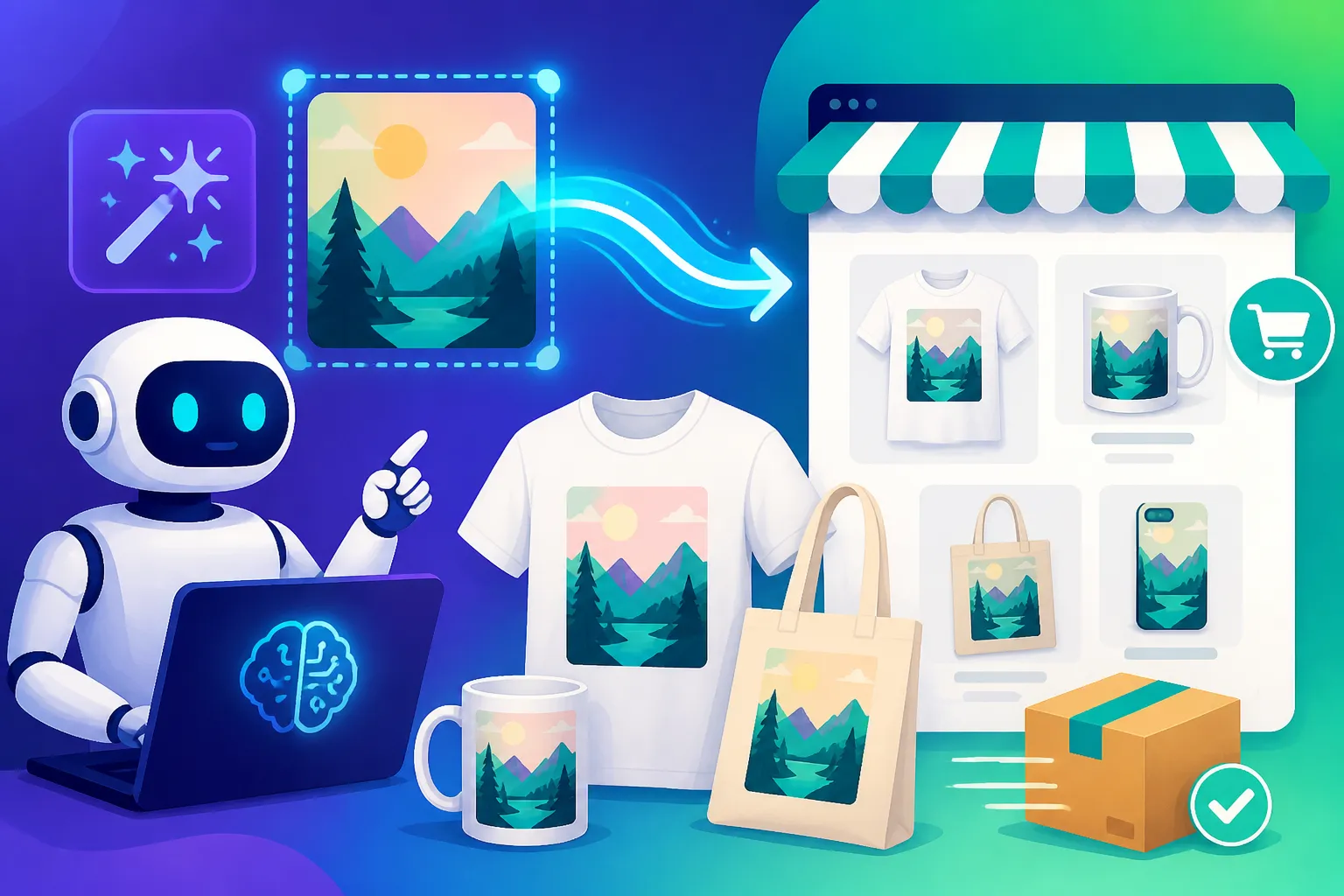
At its core, print-on-demand is a business model where you work with a supplier to customize white-label products (like t-shirts, mugs, phone cases, or posters) with your own designs, selling them on a per-order basis under your own brand. The magic? The items are only printed once a customer places an order. This means you don't hold any inventory, which dramatically reduces your financial risk and eliminates the headache of managing stock or dealing with leftover products.
Imagine this scenario: you've got an amazing design idea for a t-shirt. With traditional retail, you'd have to pay to get a batch of shirts printed, hoping they all sell. If they don't, you're stuck with unsold merchandise and a financial loss. With POD, you simply upload your design to a platform like Printful or Printify, list it on your online store (like Shopify or Etsy), and when someone buys it, the POD company prints the shirt, packages it, and ships it directly to your customer. You pay the POD company their base price for the product and printing, and you keep the profit margin. It’s a beautifully efficient system that empowers creators to focus on what they do best: designing and marketing. The biggest traditional hurdle for many has always been the sheer volume of unique designs needed to keep a store fresh and appealing.
How AI Transforms POD Design
This is where artificial intelligence steps in as your ultimate creative partner, fundamentally changing how quickly and effectively you can generate those unique designs. In the past, creating compelling designs often required significant artistic skill, expensive software, and hours of work, or the budget to hire a graphic designer. For many aspiring POD store owners, this was a major barrier.
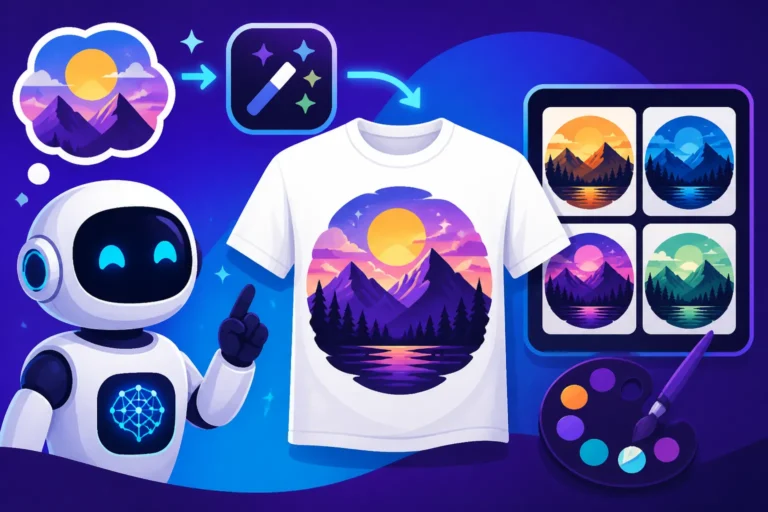
AI image generators tear down that barrier. Instead of drawing or painstakingly crafting every element, you can simply describe your vision in text prompts, and the AI conjures up visual concepts in moments. This isn't just about speeding up the design process; it's about unlocking creative possibilities that might have been out of reach before. You can iterate on ideas faster than ever, explore countless styles, and generate variations with minimal effort. Think about the ability to generate a dozen different t-shirt graphics in an hour, each with a unique aesthetic, compared to days or weeks of manual work. AI tools like Midjourney, DALL-E, or Ideogram can produce intricate patterns, whimsical illustrations, photorealistic scenes, or even abstract art based on your textual input. This allows you to fill your store with a diverse catalog quickly, test different niches and trends, and ultimately, discover what resonates most with your audience without a massive investment in design time or costs. The sheer volume and originality of designs you can achieve with AI is truly transformative for the print-on-demand landscape.
Setting Up Your AI-Powered POD Store
Starting a print-on-demand store might sound complex, but by breaking it down into manageable steps and leveraging AI, it becomes incredibly accessible. The key is methodical planning, from niche selection to tool integration.
Choosing Your Niche and Target Audience
Before you even think about generating designs, you need to figure out who you're selling to and what makes your store unique. This isn't just about picking a random theme; it's about identifying a specific group of people with a shared interest or pain point and creating products that speak directly to them. Without a niche, your marketing efforts will be scattered, and your store might get lost in the vast sea of generic online shops.
Think about common frustrations or passions. Are there specific hobbies, inside jokes, pop culture references, or community values that a certain group holds dear? For instance, instead of just "dog lovers," consider "rescue dog advocates" or "owners of specific dog breeds like corgis." This level of specificity helps you tailor your designs, messaging, and even your marketing channels. You can use search engines and social media platforms to research trending topics, popular hashtags, and underserved audiences. AI can even subtly assist here, by helping you brainstorm niche ideas or analyze popular search terms for creative inspiration. Once you've honed in on a niche, you'll have a much clearer direction for your design prompts, ensuring your AI-generated art is relevant and appealing to your target customers.
Selecting the Right POD Platform and AI Tools
Once you have your niche locked down, the next critical step is choosing the right tools to bring your vision to life. This involves both your print-on-demand partner and your AI image generator.
Print-on-Demand Platforms
There are several excellent POD platforms, each with its own strengths. The best choice for you often depends on the products you want to sell, your budget, and how much control you want over the fulfillment process.
- Printful: Known for its high-quality products, excellent customer service, and a wide range of integration options with e-commerce platforms like Shopify, Etsy, Wix, and WooCommerce. They offer a great selection of apparel, home goods, and accessories.
- Printify: Offers a wider network of print providers, allowing you to choose suppliers based on price, location, and product quality. This can sometimes lead to more competitive pricing, though quality can vary between providers. It's also well-integrated with major e-commerce platforms.
- Gelato: Focuses on global reach with local production, which can mean faster shipping and potentially lower costs for international customers. They also emphasize sustainable printing options.
Before committing, it's wise to review their product catalogs, pricing structures, shipping times, and return policies. Order a few samples of products you plan to sell to personally assess the quality of the print and the base item. This step is crucial; you don't want your customers to be disappointed.
AI Image Generators
Now, for the exciting part – choosing your AI art studio! The landscape of AI image generators is constantly evolving, with new tools emerging and existing ones improving rapidly. Your choice might depend on the specific aesthetic you're aiming for, your budget, and ease of use. If you're looking for an in-depth comparison, check out our guide on Best AI Image Generator Comparison.
Here’s a look at some popular options for crafting designs for your print-on-demand store:
| AI Image Generator | Key Strengths for POD | Pricing Model | Ease of Use |
|---|---|---|---|
| Midjourney | High artistic quality, excellent for unique styles, abstract, and detailed concepts. Strong community for prompt sharing. | Subscription-based. | Moderate (Discord-based, but evolving web interface). |
| DALL-E (via ChatGPT) | Great for general concepts, good at understanding complex prompts, consistent style for simple designs. Integrated into a conversational AI. | Credit-based within ChatGPT Plus. | High (direct text prompt). |
| Ideogram | Exceptional at rendering text within images, which is vital for slogans and typography-heavy designs. | Free tier with paid plans. | High (direct text prompt). |
| Adobe Firefly | Strong for vector-style graphics, commercial safety (indemnification on some plans), seamless integration with Adobe ecosystem. | Free tier with paid plans. | High (web-based, familiar UI for Adobe users). |
| Leonardo AI | Offers a wide range of models and tools, including image upscaling, great for fine-tuning specific details, control over output. | Free tier with paid plans. | Moderate (more features mean a steeper learning curve). |
For a deeper dive into the free options, you might find our article on the Best Free AI Image Generators particularly helpful.
Generating Designs with AI
This is where your creative vision meets artificial intelligence. Generating designs effectively requires a bit of practice and understanding of how to communicate your ideas to the AI.
Crafting Effective Prompts
Think of your prompt as a conversation with a highly skilled, but literal, artist. The more descriptive and specific you are, the better the results. Start with the core subject, then add details about style, color, mood, lighting, composition, and even specific elements you want to include or exclude. For example, instead of "a cat," try "a regal Siamese cat wearing a tiny crown, sitting on a velvet cushion, in the style of a whimsical watercolor painting, vibrant colors, soft lighting, intricate details, no background elements." If you're creating a product like a t-shirt with a slogan, a tool like Ideogram, which excels at text rendering, would be an excellent choice. You can learn more about how to get the most out of your textual inputs by reading our comprehensive How to Write AI Image Prompts guide.
Iteration and Refinement
Rarely will your first prompt yield the perfect design. AI generation is an iterative process. Generate several options, pick the ones that are closest to your vision, and then refine them. Most AI tools allow you to generate variations of an existing image, or you can adjust your prompt to guide the AI closer to what you want. Experiment with different keywords, artistic styles (e.g., "minimalist vector art," "vintage comic book style," "detailed digital painting"), and aspect ratios. The goal is to produce high-resolution images that are visually appealing and suitable for printing on various products. You'll also want to make sure your AI-generated images are clean and free of artifacts. If you encounter any issues, our guide on How to Fix Bad AI Image Results can provide some useful tips.
Ensuring Commercial Use Rights and Quality
Before using any AI-generated image for your store, it's absolutely crucial to understand the commercial use rights associated with the AI tool's terms of service. Most paid AI image generators, and some free ones, grant you commercial rights to images you create while subscribed or using their platform. However, it’s your responsibility to verify this. For more specific information on this topic, consider reading our article on How to Make AI Images Commercially Safe.
Additionally, print quality is paramount. Ensure the AI generates images at a sufficiently high resolution (DPI – dots per inch) for your chosen products. T-shirts typically require at least 150-300 DPI at the desired print size. If your initial AI output isn't high enough, you may need to use an upscaling tool. There are many great options out there, and our guide on How to Upscale AI Images can walk you through the process. Remember, a sharp, clear design will always look better than a pixelated one, even if the underlying concept is brilliant.
Marketing and Scaling Your AI-Driven POD Business
Having fantastic AI-generated designs is only half the battle. To truly succeed with your print-on-demand store, you need to effectively market your products and consider the practicalities of scaling and legal compliance.
Branding and Store Setup
Your brand is more than just a logo; it's the entire experience your customers have with your store, from the aesthetics to the tone of your communication. With AI handling much of the heavy lifting in design, you can dedicate more time to crafting a cohesive brand identity.
Creating a Memorable Brand Identity
Start by giving your store a memorable name that reflects your niche. Develop a consistent visual style that carries across all your designs and marketing materials. What colors, fonts, and overall vibe do you want to convey? AI can even help you generate Best AI Image Generator for Logos for your brand, or create background textures and patterns to use on your website. Once you have your designs, leverage AI-generated mockups or use tools that integrate with POD platforms to showcase your products realistically. Seeing a t-shirt design on a model or a mug in a cozy cafe setting makes a huge difference in converting browsers into buyers. You can even learn How to Create AI Product Photos for Free to make your product listings shine.
Setting Up Your Online Storefront
Most POD platforms integrate seamlessly with popular e-commerce platforms like Shopify, Etsy, WooCommerce, or even your own website built with Wix or Squarespace. Choose a platform that offers the features you need and is easy for you to manage.
- Shopify: Offers robust features, scalability, and extensive app integrations, making it ideal for those looking to build a professional, dedicated e-commerce site. It has a monthly subscription fee.
- Etsy: Perfect for handmade and unique goods, Etsy provides a built-in audience of buyers looking for creative items. The fees are per listing and a percentage of sales.
- WooCommerce: A free plugin for WordPress, offering immense flexibility and control for those already familiar with WordPress. You'll need to manage your own hosting.
Whichever platform you choose, ensure your store is easy to navigate, mobile-friendly, and has clear product descriptions that highlight your designs and target audience.
Marketing Your Products
Even the most brilliant AI-generated designs won't sell themselves. Effective marketing is crucial to drive traffic to your store and convert visitors into loyal customers.
Harnessing Social Media and Content Marketing
Social media is a powerful, often free, tool for reaching your target audience. Identify which platforms your niche frequents (e.g., Instagram and Pinterest for visually-driven products, TikTok for trending content, Facebook Groups for specific communities). Create engaging content featuring your products. Use your AI tools to generate stunning social media graphics or even short video clips that showcase your designs in action. Don't just post product photos; share behind-the-scenes glimpses of your design process (the AI part!), customer testimonials, or lifestyle shots that help people envision themselves using your products. For more general content ideas, think about using AI for your AI for Blog and Article Images to support blog posts about your niche.
Search Engine Optimization (SEO) for Product Listings
Optimizing your product listings for search engines is vital for organic traffic. Research keywords that your target audience might use when searching for products like yours. Include these keywords naturally in your product titles, descriptions, and tags. For example, if you sell t-shirts for "cat lovers," include terms like "funny cat t-shirts," "unique cat gifts," or "cat mom apparel." High-quality product images (AI-generated, of course!) also contribute to better SEO, as they improve user experience.
Paid Advertising Strategies
Once you have some sales momentum, consider investing in paid advertising on platforms like Facebook, Instagram, or Google. AI can assist here too, by helping you generate compelling ad creatives and variations for A/B testing. Targeting specific demographics and interests can yield impressive results, bringing your unique AI-driven designs directly to the people most likely to buy them. Remember to start small, test your ads, and scale up what works.
Legal and Commercial Considerations
While AI offers incredible opportunities, it also introduces new considerations, especially regarding intellectual property and commercial use. It's important to navigate these waters carefully.
Understanding Copyright and AI-Generated Art
The legal landscape around AI-generated art is still evolving. In many jurisdictions, images created solely by AI, without significant human creative input, may not be eligible for copyright protection in the same way human-created art is. However, your use of these images for commercial purposes, and any modifications you make to them, can still be protected under your brand. It's generally best practice to use AI tools that explicitly grant commercial rights for the images generated on their platforms.
Trademarks and Unique Designs
Before launching a product, especially if it includes text or unique phrases, always perform a quick trademark search. You don't want to inadvertently infringe on someone else's registered trademark. While AI can create unique designs, the generated output might sometimes coincidentally resemble existing copyrighted or trademarked material, so a quick check can save you headaches down the line. Focus on generating truly original concepts or significantly modifying AI outputs to create distinct works.
Indemnification and Commercial Safety
Some AI image generators, like Adobe Firefly, offer indemnification on certain paid plans, meaning they will cover legal costs if an image generated with their tool is found to infringe on a third party's copyright. This can be a significant benefit for businesses relying heavily on AI for commercial content. Even without indemnification, by understanding the terms of service of your chosen AI tool and focusing on generating unique, distinct designs, you can operate your print-on-demand store confidently and successfully.
Disclaimer
The information provided in this article is for general informational purposes only and does not constitute legal, financial, or professional advice. While we strive to provide accurate and up-to-date content, the field of AI and e-commerce is rapidly evolving. Always consult with relevant professionals or refer to official guidelines for specific advice tailored to your situation.