The Big Three AI Image Generators Compared
It feels like just yesterday we were marveling at the first glimpses of AI creating art, and now, the landscape of AI image generation is absolutely buzzing. For many creators, marketers, and even hobbyists, the sheer choice can be overwhelming. You've probably heard names like Midjourney, DALL-E, and Stable Diffusion thrown around, but figuring out which one actually fits your workflow and delivers the results you need can feel like trying to pick out a needle in a haystack. This guide is designed to cut through the noise, offering a detailed, side-by-side comparison of these "Big Three" AI image generators to help you understand their strengths, weaknesses, and ideal use cases.
Understanding the Heavyweights in AI Image Generation
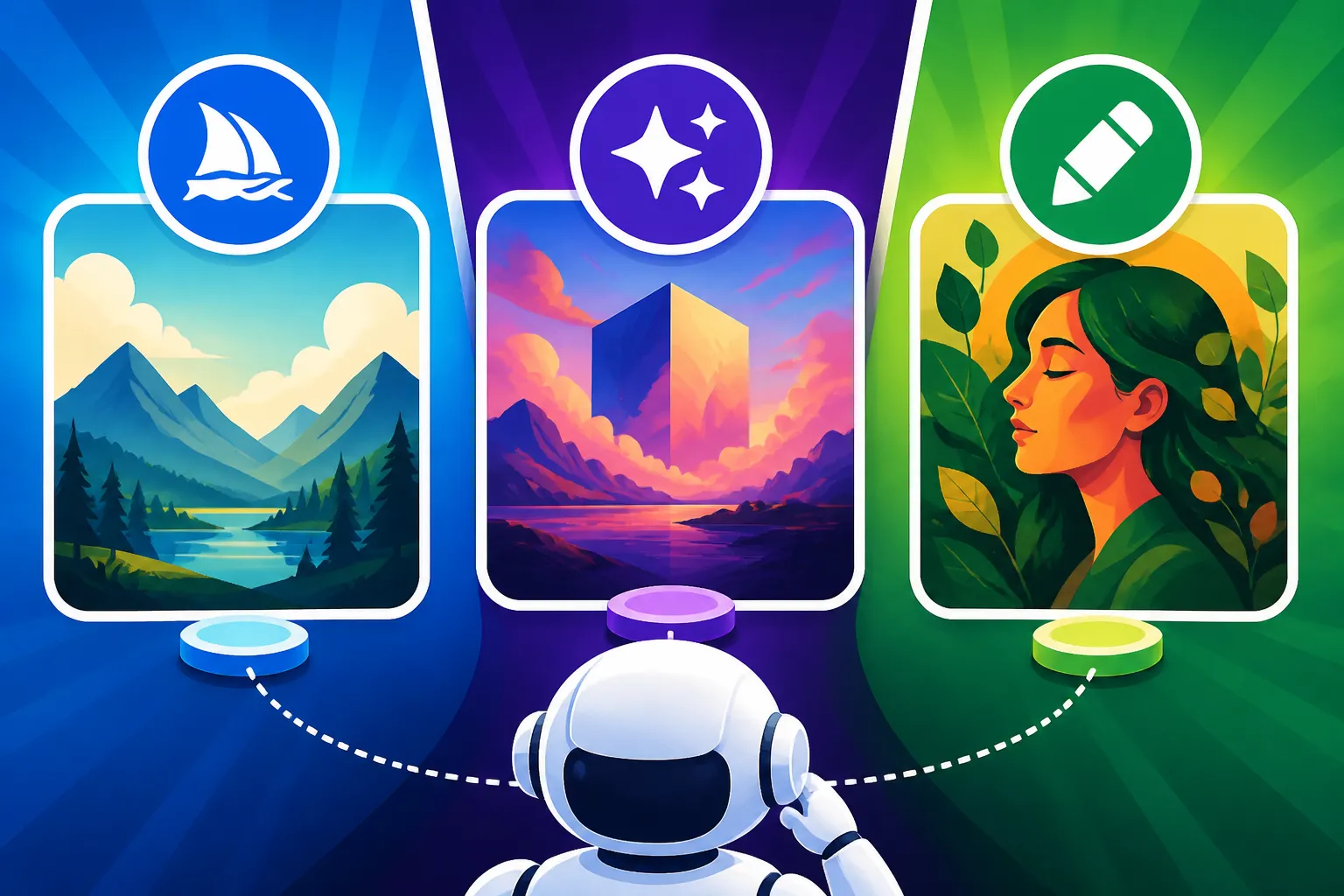
When we talk about the "Big Three" in AI image generation, we're generally referring to Midjourney, DALL-E, and Stable Diffusion. These three have really carved out their niches and, for better or worse, have become the benchmarks against which other AI tools are often measured. They represent different philosophies in AI art, from user experience to raw power and customization, and understanding these differences is key to making an informed choice.
Midjourney: The Artistic Powerhouse
Midjourney burst onto the scene with an almost mystical ability to create stunning, often surreal, and highly aesthetic images right out of the gate. It quickly gained a reputation for its inherent artistic bias, consistently producing outputs that felt professionally rendered and often required minimal prompting to look good. While it started exclusively on Discord, its user-friendly approach to prompting and the sheer beauty of its results made it a favorite among artists and casual users alike. If you’re looking for high-quality, inspiring visuals with a particular aesthetic flair, Midjourney often feels like your personal artistic collaborator.
DALL-E: The Intuitive Conceptualizer
Developed by OpenAI, DALL-E brought AI image generation to a wider audience, especially with its integration into platforms like ChatGPT. It's renowned for its ability to interpret complex, nuanced prompts and generate images that are surprisingly accurate to textual descriptions. While its artistic style might be less distinct than Midjourney's, DALL-E excels at conceptual illustration and creating images that are directly usable for a wide range of informational or marketing purposes. Its strength lies in its ability to quickly bring abstract ideas to visual life with remarkable fidelity to your prompt's core meaning. For many, its ease of use and straightforward web interface make it incredibly appealing, especially if you're already familiar with the OpenAI ecosystem.
Stable Diffusion: The Open-Source Challenger
Stable Diffusion is the wildcard, an open-source model that completely democratized AI image generation. Unlike Midjourney and DALL-E, which are typically accessed through proprietary web interfaces or Discord bots, Stable Diffusion can be run locally on your own computer (if you have the hardware) or through numerous web services built on its core technology. This open-source nature means it’s incredibly versatile, customizable, and has an active, innovative community constantly developing new models, tools, and extensions. While it might have a steeper learning curve, especially for local setups like Automatic1111, the level of control and the sheer breadth of artistic styles you can achieve are unparalleled. This makes it a favorite for developers, power users, and those who demand ultimate flexibility.
A Head-to-Head Comparison of Core Features
Now that we've introduced our contenders, let's dive into the nitty-gritty of what makes each of them tick and how they stack up against each other in the aspects that matter most to users.
Image Quality and Distinctive Artistic Styles
This is often the first thing people notice, and it's where these three tools really begin to differentiate themselves. The "look" of an AI-generated image can be quite specific to the model that created it.
Midjourney, especially with its latest iterations like Midjourney V7, is arguably the king of aesthetics straight out of the box. Its images often have a polished, dreamlike, or almost cinematic quality. It's fantastic for generating evocative landscapes, intricate character designs, and abstract concepts with a strong artistic touch. If you ask for a "magical forest," Midjourney will likely give you something breathtakingly ethereal. However, this strong artistic bias can sometimes make it harder to achieve truly neutral, photorealistic, or very specific, non-stylized outputs without careful prompting. You might find its output leaning towards a particular aesthetic even when you're aiming for something plainer. For a deeper dive, check out our article on Midjourney Image Quality Tested and Reviewed.
DALL-E, particularly the version integrated into ChatGPT, tends to produce images that are more literal interpretations of your prompts. Its strength lies in its ability to accurately render specific objects, scenes, and compositions as described. While it can produce beautiful art, its default style is often perceived as more illustrative or graphic design-oriented rather than having Midjourney's signature painterly feel. It's excellent for creating visual concepts, product mockups, or straightforward informational graphics. It's also remarkably good at handling text within images, though not always perfectly. When comparing DALL-E Image Quality Tested and Reviewed against others, you'll often see its strong suit is fidelity to the prompt's content.
Stable Diffusion, being open-source and highly modular, doesn't really have one default artistic style. Its quality and aesthetic are entirely dependent on the specific model (or "checkpoint") you're using. You can download and load models trained for photorealism, anime, comic book art, architectural renders, abstract patterns, and everything in between. This means its potential quality is limitless, but it also means you have to put in the work to find and integrate the right models. Out-of-the-box, its base models might produce less refined results than Midjourney, but with the right setup and fine-tuning, it can surpass both in specific styles and detail. For those who want to understand this versatility, our guide on Stable Diffusion Image Quality Tested and Reviewed goes into depth.
Ease of Use and User Experience
How easy is it to jump in and start generating images? This is a huge factor, especially for beginners.
Midjourney traditionally operated almost exclusively through Discord. Users would type commands into a chat window, and the bot would generate images. While this might sound daunting, the community aspect and the relative simplicity of its core commands made it surprisingly accessible for many. In recent times, Midjourney has been rolling out a dedicated web app, which streamlines the process even further and offers a more conventional user interface. Learning the essential parameters is fairly straightforward, making it quick to get good results. You can find more about the different ways to interact in our article on Midjourney Web App vs Discord.
DALL-E, especially through ChatGPT, offers arguably the most frictionless user experience. You simply type your prompt into a text box, much like you would a regular query, and DALL-E generates images directly within the chat interface. It’s entirely web-based, requiring no downloads or complex setups. This makes it incredibly easy for anyone familiar with a web browser to start creating. Its straightforward approach is a huge plus for those who just want to get to the image quickly without diving into technicalities. Our guide on DALL-E in ChatGPT How Good Is It explores this integration.
Stable Diffusion has the steepest learning curve, particularly if you opt for a local installation like Automatic1111 web UI. This involves downloading software, models, and potentially extensions, and navigating a more complex interface with many sliders, checkboxes, and settings. However, numerous web-based services have emerged (like DreamStudio by Stability AI, or platforms like Civitai, Leonardo AI, or Playground AI) that offer more user-friendly interfaces for Stable Diffusion. While these platforms simplify the experience, they still typically offer more granular controls than Midjourney or DALL-E, meaning there's still a bit more to learn. For those asking Is Stable Diffusion Still Worth Learning, the answer is a resounding yes, especially for power users.
Customization and Creative Control
For many serious creators, having control over the output is paramount. This goes beyond just writing a good prompt.
Midjourney offers a good degree of control through various parameters you can add to your prompts, such as aspect ratios, stylization levels, chaos, and seed values for reproducibility. You can also use image prompts to guide the AI with existing visuals. However, it's a more curated experience; you're often guiding its inherent artistic engine rather than dictating every pixel. For example, while you can ask for "cinematic lighting," you don't have direct sliders for light source position or intensity like you might in a 3D renderer. Diving into Midjourney Parameters Explained can show you the extent of control available.
DALL-E provides less explicit control parameters than Midjourney. Your primary means of control is the prompt itself, and its ability to understand nuanced instructions. It does offer basic editing tools like inpainting (filling in parts of an image) and outpainting (extending an image beyond its original canvas), which are powerful for refining results. However, you don't typically tweak "style weights" or "seed values" in the same visible way as other tools. Its strength is in responding to natural language, making it great for direct, descriptive prompts.
Stable Diffusion is the undisputed champion of customization. Through its various implementations, you gain access to an incredible array of tools. You can choose from countless base models, apply LoRAs (Low-Rank Adaptation) to subtly or drastically alter styles or characters, use ControlNet to precisely guide composition and pose with reference images, perform intricate inpainting and outpainting, and even train your own models. This level of control means you can achieve highly specific artistic visions, maintain character consistency across multiple images, or even generate images that closely mimic a real-world photograph. For artists who want to fine-tune every aspect, mastering How to Use ControlNet in Stable Diffusion or How to Use LoRAs in Stable Diffusion is a game-changer.
Pricing and Accessibility
The cost and ease of access can be a deal-breaker for many, especially if you're just dabbling or operating on a tight budget. Our article on Free vs Paid AI Image Generators delves into this broader topic, but let's break down the Big Three.
Midjourney operates on a subscription model, offering various tiers with different amounts of "fast GPU time" (how quickly your images generate) and commercial usage rights. There isn't a truly free tier, though they occasionally offer free trials for limited generations. Paid plans can range from quite affordable for casual use to more substantial for professionals who need unlimited fast generations. You'll want to check out Midjourney Pricing and Plans Explained for the most up-to-date details.
DALL-E's most common access point is through a ChatGPT Plus subscription, which includes DALL-E 3 image generation capabilities. This means you're paying for a suite of AI tools, not just image generation. OpenAI also offers DALL-E via an API with a pay-as-you-go credit system, which can be cost-effective for high-volume or integrated applications. While there might be occasional free promotions or trials, continuous free access is generally not available.
Stable Diffusion is unique in its accessibility. As an open-source model, the core software is entirely free to download and run locally on your own hardware. This means if you have a powerful enough GPU, your only "cost" is electricity and the time it takes to learn the ropes. If local execution isn't feasible, numerous third-party websites offer Stable Diffusion as a service, often with free tiers that provide a limited number of generations or slower processing, alongside paid subscription options. This makes it incredibly flexible for different budgets and technical capabilities. For anyone on a tight budget, exploring Best Free AI Image Generators will definitely lead you to Stable Diffusion-based options.
Commercial Use and Licensing
This is a critical area for anyone using AI images for professional work. The legal landscape around AI-generated art is still evolving, but understanding the current terms is crucial.
Midjourney's terms generally allow commercial use of images generated by paid subscribers. However, there are nuances, especially regarding company size and revenue, which can affect the terms. It's always best to review their official terms of service for the most current information. For most freelancers and small businesses, the standard paid plans typically grant commercial rights. Understanding Who Should Use Midjourney An Honest Take often involves considering these commercial terms.
DALL-E, when accessed through a paid ChatGPT Plus subscription or API, generally grants users commercial rights to the images they create. OpenAI has also been proactive in offering indemnification for certain enterprise users, meaning they would cover legal costs if an image generated by DALL-E were to infringe on someone else's copyright. This offers a significant peace of mind for businesses. Our guide on DALL-E Pros and Cons for Creators often highlights this aspect as a major benefit.
Stable Diffusion, due to its open-source nature, often uses licenses like the CreativeML Open RAIL-M License. Generally, this license is quite permissive for commercial use, but it places the responsibility on the user to ensure the content generated does not infringe on existing copyrights or violate any laws. Since you can use custom models (often created by the community), the specific terms can become more complex, as some model creators might have their own stipulations. It's vital to check the license of any specific model you download and use. This is especially relevant for those asking about Best AI Image Generator for Commercial Use.
Use Cases: Which Tool for Your Specific Needs?
Now that we've broken down their features, let's consider practical scenarios to help you decide.
For Artistic Inspiration and Unique Visuals
If your goal is to generate stunning, high-quality art for personal projects, digital painting inspiration, or unique social media visuals, Midjourney is often the top choice. Its default aesthetic is incredibly strong, and you can often get breathtaking results with relatively simple prompts. It's like having a highly skilled digital artist at your fingertips who understands aesthetics intrinsically. Many artists use it to quickly prototype ideas or generate mood boards that spark further creativity. If you need something that screams "art," Midjourney is your go-to.
For Quick, Conceptual Images and General-Purpose Graphics
When you need an image that directly illustrates a concept, a product, or a scene for a blog post, presentation, or marketing material, and you need it fast and without fuss, DALL-E truly shines. Its ability to accurately translate complex natural language into coherent visuals, combined with its user-friendly interface, makes it ideal for content creators, marketers, and anyone who needs visual aids without wanting to become an expert prompt engineer. Its integration within ChatGPT also makes it a powerful tool for generating images right within your content creation workflow. If you're looking for Best AI Image Generator for Blog Images or Best AI Image Generator for Marketing Images, DALL-E is definitely a strong contender.
For Maximum Control, Customization, and Niche Styles
If you're a power user, developer, or artist who needs unparalleled control over every aspect of your image generation, or if you need to generate images in very specific, niche styles (e.g., highly photorealistic portraits, particular anime styles, specific historical art movements), then Stable Diffusion is your champion. Its open-source nature means you can integrate it into custom workflows, fine-tune models to your exact specifications, and use advanced techniques like ControlNet for pixel-perfect guidance. The learning curve is higher, but the ceiling for creative control and specialized output is virtually limitless. It's also fantastic for creating AI Images for Game Development or for those who want to explore the full spectrum of AI art possibilities.
Here's a quick summary table to help visualize the differences:
| Feature | Midjourney | DALL-E (via ChatGPT) | Stable Diffusion (General) |
|---|---|---|---|
| Image Quality / Style | Highly artistic, dreamlike, cinematic | Conceptual, literal, illustrative, good text | Highly versatile, depends on model (photorealism, anime, abstract, etc.) |
| Ease of Use | Moderate (Discord-based, improving web UI) | Very easy (web-based, natural language) | Moderate to Difficult (local setup), Easier (web services) |
| Customization | Good (parameters, image prompts) | Basic (prompting, inpainting/outpainting) | Excellent (models, LoRAs, ControlNet, inpainting) |
| Accessibility | Paid subscription (no free tier) | Paid (ChatGPT Plus, API) | Free (local), Paid/Free tiers (web services) |
| Commercial Use | Generally allowed (paid tiers) | Generally allowed (paid tiers, indemnification) | Generally allowed (open-source license, user responsibility) |
| Ideal For | Artistic inspiration, unique visuals | Quick concepts, general graphics, marketing | Advanced users, niche styles, maximum control |
Final Thoughts on Choosing Your AI Image Tool
Ultimately, there isn't a single "best" AI image generator among the Big Three; it truly depends on your specific needs, skill level, and budget.
If you prioritize artistic quality and want to generate stunning images with minimal fuss, and you're comfortable with a subscription, Midjourney is an excellent choice. It’s perfect for visual artists, designers looking for inspiration, and content creators who need beautiful, high-impact visuals. You might find our piece on Midjourney vs DALL-E Which Is Better or Midjourney vs Stable Diffusion Compared helpful for more granular comparisons.
If ease of use and direct interpretation of your ideas are paramount, especially if you're already in the OpenAI ecosystem, DALL-E will serve you exceptionally well. It's fantastic for generating quick visuals for presentations, blog posts, social media, and brainstorming creative concepts. For many, its convenience is a huge selling point.
If you demand maximum control, are willing to invest time in learning, or require specific niche styles that only custom models can provide, then Stable Diffusion is your powerhouse. It’s ideal for advanced artists, developers, and those who want to deeply customize their AI art workflow, even if it means a steeper initial climb. For further reading, consider DALL-E vs Stable Diffusion Compared.
Many creators even find success by combining these tools, using one for initial concepts and another for final polishing or specific edits. The world of AI image generation is evolving rapidly, and staying curious and experimental is the best way to leverage these incredible technologies.
Disclaimer
The information provided in this article is for general informational purposes only and does not constitute professional advice. While we strive to provide accurate and up-to-date information, the field of AI image generation is constantly evolving. Always consult the official terms of service and licensing agreements of any AI tool you use, especially for commercial purposes.