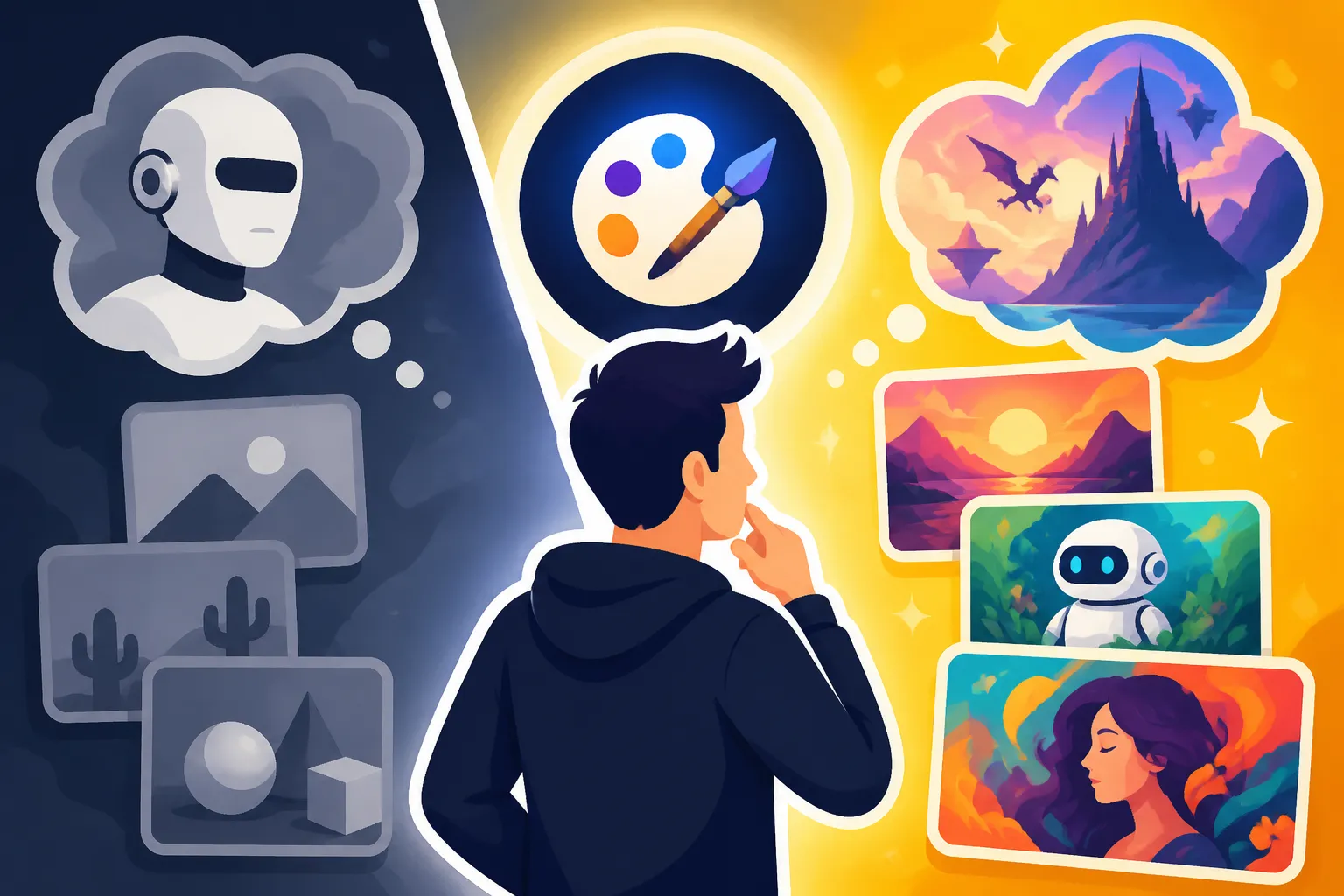
Is Stable Diffusion Still Worth Learning
The world of AI image generation changes at a dizzying pace, doesn't it? One day you hear about a revolutionary new tool, the next it feels like everyone's moved on to something else. It's completely understandable to feel overwhelmed and wonder if investing your time and energy into learning a specific platform, especially one that's been around for a bit like Stable Diffusion, is still a worthwhile endeavor. This guide is here to cut through the noise, validate those very real frustrations, and help you determine if Stable Diffusion still holds its weight and is worth adding to your creative toolkit in today's dynamic landscape.
Understanding the Current AI Image Landscape
It feels like just yesterday we were all marveling at the first glimpses of AI art, and now it's a bustling metropolis of tools and technologies. The sheer volume of new generators popping up, each promising something slightly different, can make anyone's head spin. From simple text-to-image interfaces to complex local installations, the landscape is incredibly diverse, and choosing where to focus your learning can feel like a high-stakes decision. You want to make sure your efforts translate into real, usable skills, not just a fleeting fascination.
The Rapid Evolution of AI Art Tools
In the blink of an eye, what was cutting-edge yesterday can feel dated today. When tools like DALL-E and Midjourney first burst onto the scene, they democratized image creation in ways we never imagined. Suddenly, anyone could conjure incredible visuals with simple text prompts. Then came the open-source movement, spearheaded by Stable Diffusion, which took the power out of the hands of big tech companies and put it directly into the community. This open-source nature ignited an explosion of innovation, with countless custom models, extensions, and interfaces emerging. It's a fantastic time to be a creator, but it also means constant adaptation and evaluation of what's truly valuable.
Just look at the incredible strides made in photorealism or the ability to embed text directly into images—features that were once a pipe dream are now commonplace thanks to advancements across the board. Every few months, there's a new version of a core model, or a brand new contender that claims to offer better results, faster speeds, or more user-friendly interfaces. It's a thrilling, albeit sometimes exhausting, ride for anyone trying to keep up.
Where Stable Diffusion Stands Against Newer Competitors
In this ever-shifting terrain, Stable Diffusion remains a formidable player, but its role has evolved. When it first arrived, its main draw was its open-source nature and the ability to run it locally on your own hardware, offering a level of control and privacy that many commercial tools couldn't match. Today, we have sophisticated, user-friendly platforms like Midjourney V7 and Adobe Firefly that deliver stunning results with minimal fuss, often in a cloud-based environment. There's also Ideogram, which has made incredible strides in text rendering within images, a common weakness for many AI generators.
So, where does Stable Diffusion fit in? While some newer tools might offer a more streamlined experience or specific niche strengths, Stable Diffusion continues to excel in areas like unparalleled customization and the sheer breadth of its community-driven ecosystem. It might not be the absolute easiest tool to jump into, but its depth offers rewards that many simpler platforms simply can't. It's less about being "better" or "worse" than competitors and more about understanding its unique strengths and whether those align with your specific creative goals.
Key Advantages of Learning Stable Diffusion
Even with the rise of many slick, easy-to-use AI art generators, Stable Diffusion hasn't faded into obscurity. In fact, for a certain type of creator, it's more relevant than ever. Its core advantages address some of the biggest pain points many artists, designers, and developers face when working with AI, offering solutions that many closed-source or simpler tools just can't touch. These advantages are precisely why a good chunk of the community still swears by it and why it continues to evolve.
Unparalleled Customization and Control
This is arguably Stable Diffusion's strongest selling point. Unlike many plug-and-play AI image generators where you mostly input a prompt and get a result, Stable Diffusion offers an astonishing degree of granular control over every aspect of your image generation process. Think about it: you can choose from hundreds, if not thousands, of custom-trained models (often called "checkpoints") that specialize in specific aesthetics, from hyperrealistic photography to anime styles, abstract art, or even highly specific historical looks. You're not limited to the default model an API provides.
Beyond the base model, you can layer on LoRAs (Low-Rank Adaptation), which are small add-on models that introduce specific styles, characters, objects, or poses without retraining the entire model. Want a consistent character across multiple images? LoRAs are your friend. Need precise pose control? ControlNet, a game-changer for Stable Diffusion, allows you to dictate human poses, depth maps, line art, and more from reference images. This level of fine-tuning means you can guide the AI to create exactly what's in your head, rather than just hoping for the best. For those who feel stifled by the black-box nature of other tools, the control offered by Stable Diffusion is incredibly liberating. You can explore how to use ControlNet in Stable Diffusion to see this in action.
Open-Source Freedom and Community Support
The open-source nature of Stable Diffusion means a few critical things. First, it means transparency. The underlying code is available for anyone to inspect, understand, and even modify. This fosters a level of trust and innovation that closed-source models can't replicate. Developers around the world contribute to its evolution, constantly improving algorithms, creating new features, and optimizing performance. This collective effort accelerates progress in a way that centralized development simply can't match.
Second, it means an incredibly vibrant and supportive community. If you run into an issue, need a specific kind of model, or want to learn an advanced technique, chances are there's a Discord server, a Reddit community, or a forum thread with enthusiastic users ready to help. This communal spirit is a huge asset for learners. You're not just buying into a piece of software; you're joining a global network of fellow creators and innovators. This rich ecosystem is constantly generating new custom models, extensions, and workflows, ensuring that Stable Diffusion remains at the forefront of what's possible. It's a stark contrast to more walled-garden approaches, offering a collaborative spirit that is deeply inspiring.
Cost-Effectiveness and Local Deployment
Let's be real, subscription costs for many AI tools can really add up, especially if you're a heavy user or just starting out. This is where Stable Diffusion truly shines as a budget-friendly option. While there are cloud-based services that host Stable Diffusion, the real magic for many lies in the ability to run it directly on your own computer. Once you've set it up, the only ongoing cost is your electricity bill. This is a massive advantage for creators who need to generate a large volume of images, experiment endlessly without worrying about credit consumption, or simply prefer to keep their work private and off third-party servers. If you're wondering Is Stable Diffusion Really Free: What to Know, the answer is largely yes, if you have the hardware.
Setting up Stable Diffusion locally means you bypass monthly subscription fees and credit systems. This not only saves money but also removes the pressure of "wasting" credits on experimental prompts. You can iterate, refine, and generate to your heart's content without a ticking financial clock. For students, hobbyists, or small businesses with limited budgets, this can be the difference between being able to use AI image generation extensively and being priced out. The freedom of local deployment, combined with the vast array of free custom models and tools available, makes it an incredibly cost-effective solution for long-term use. You can explore How to Run AI Image Models Free Locally to understand the setup.
Potential Challenges and Considerations
While Stable Diffusion offers incredible power and flexibility, it's not without its quirks. Just like any powerful tool, it demands a certain level of engagement and understanding. It's important to go into learning it with eyes wide open, recognizing that some aspects might present a steeper climb than the more streamlined, beginner-friendly options out there. These aren't necessarily drawbacks, but rather characteristics that shape the learning experience and overall utility of the platform.
Steeper Learning Curve Compared to Simpler Tools
Let's be honest, Stable Diffusion isn't a point-and-click affair right out of the box for beginners. If you're coming from something like Canva AI or even basic DALL-E in ChatGPT, the interface (often Automatic1111's web UI or ComfyUI) can feel overwhelming at first. There are numerous tabs, sliders, settings, and parameters that can initially seem like a cryptic maze. You're not just typing a prompt; you're dealing with samplers, steps, CFG scale, negative prompts, seed numbers, upscalers, and much more. Learning to effectively combine these elements for desired results takes time and practice.
The initial setup itself can be a hurdle for those unfamiliar with command lines or managing software dependencies. It’s not plug-and-play like installing a simple app. However, this complexity is the trade-off for the unparalleled control it offers. It’s akin to learning to drive a race car versus an automatic sedan – one gets you there, the other lets you push the limits. For many, the initial investment in learning pays off exponentially in creative freedom, but it's a commitment nonetheless. If you're looking for instant gratification without diving deep, other tools might be a better starting point.
Hardware Requirements for Optimal Performance
While Stable Diffusion can run on a wide range of hardware, getting genuinely fast and high-quality results, especially with larger image sizes or complex workflows, typically requires a dedicated graphics card (GPU) with ample VRAM. We're talking about modern Nvidia or AMD GPUs with at least 8GB, but ideally 12GB or more, for comfortable generation. Trying to run it on an older laptop with integrated graphics or insufficient VRAM will lead to incredibly slow generation times, frustrating crashes, or severely limited capabilities. This can be a significant barrier for some.
This hardware dependency means that while the software itself is free, there might be an unspoken "cost" in upgrading your computer if your current setup isn't up to snuff. Cloud-based Stable Diffusion services exist to circumvent this, but then you're back to paying subscription fees or credit costs, negating some of the cost-effectiveness of local deployment. Before diving deep, it's wise to assess your current hardware and consider if it meets the recommended specifications for a smooth experience. This is crucial for understanding the true value proposition, especially compared to cloud-only services like Midjourney vs Flux: Full Comparison which run entirely on remote servers.
Keeping Up with Constant Updates
The rapid development that fuels Stable Diffusion's innovation also presents a challenge: keeping up. The core models like Stable Diffusion 1.5, SDXL, and now the upcoming Stable Diffusion 3.5 are continually being refined and released. Beyond the core models, there are countless updates to interfaces (like Automatic1111), extensions, ControlNet versions, and new LoRAs emerging daily. What worked perfectly last week might have a new, improved method this week.
This constant evolution means that if you step away for a month, you might return to a slightly different landscape with new best practices or features you need to learn. While exciting for enthusiasts, it can be daunting for those who prefer a stable, unchanging environment. It requires a willingness to continuously learn, adapt, and troubleshoot. However, it also means the community is always pushing boundaries, and you'll always have access to the latest and greatest advancements. This dynamic nature is both a blessing and a curse, depending on your personal learning style and commitment.
Who Benefits Most from Learning Stable Diffusion Today?
Given its unique strengths and challenges, Stable Diffusion isn't necessarily for everyone. However, for specific groups of individuals and professionals, it offers a powerful, flexible, and often cost-effective solution that can significantly enhance their creative and technical capabilities. If you fall into one of these categories, the investment in learning Stable Diffusion could yield substantial returns.
Artists and Developers Seeking Deep Customization
If you're an artist who feels limited by the default outputs of other AI tools, or a developer who wants to integrate AI image generation into custom applications, Stable Diffusion is almost indispensable. The ability to fine-tune models with your own datasets, train custom LoRAs to capture your unique art style, or utilize advanced techniques like inpainting and outpainting for precise editing makes it a dream for those who demand ultimate control. For instance, you could use it to generate highly specific textures for 3D models or consistent character designs for a comic book.
Developers appreciate the open API and the ability to run the models locally or on private cloud instances, allowing them to build bespoke solutions without reliance on external services or restrictive terms of service. Imagine creating a tool that automatically generates social media graphics in a specific brand style using your own trained models – this level of integration and customization is where Stable Diffusion truly shines. It’s not just about creating images; it’s about building new creative workflows and tools. The extensive Stable Diffusion Prompt Guide can open up a world of possibilities for detailed control.
Those on a Budget or Prioritizing Local Control
For individuals or small businesses with tight budgets, Stable Diffusion offers an unparalleled cost-benefit ratio, especially once the initial hardware investment (if needed) is made. The freedom to generate unlimited images without worrying about credit packs or monthly fees is a huge financial relief. This makes it perfect for heavy users, experimental artists, or content creators who need a constant stream of visuals but can't afford recurring high costs. For many, it's the Best Free AI Image Generator That Actually Works beyond simple demos.
Furthermore, if data privacy and local control are paramount, Stable Diffusion is the clear winner. Generating images on your own machine means your prompts and outputs aren't necessarily being sent to third-party servers, offering a greater sense of security and ownership over your creative process. This is particularly relevant for sensitive projects, proprietary designs, or simply for those who prefer to keep their digital footprint minimal. It allows you to maintain full ownership of the process, from prompt to pixel.
Professionals Needing Specific Workflows
Beyond artists and developers, professionals in various fields can leverage Stable Diffusion for highly specific workflow needs. Marketers might use it to generate endless variations of ad creatives for A/B testing, fine-tuning elements like product placement or model expressions. Architects and interior designers can quickly visualize different design concepts, materials, and lighting scenarios, iterating much faster than traditional rendering methods. Imagine a prompt like "minimalist kitchen design, natural light, oak cabinets, marble countertop" and quickly generating dozens of options.
Even academics or researchers can use it to generate illustrative images for papers, presentations, or educational materials, maintaining a consistent visual style throughout. The adaptability of Stable Diffusion, especially with its vast ecosystem of models and extensions like ControlNet (which can recreate exact layouts or poses), means it can be tailored to almost any visual need that benefits from automated generation with fine control. If your current workflow is bottlenecked by manual image creation or limited by other AI tools, Stable Diffusion could be the solution you've been looking for.
Stable Diffusion Learning Considerations
To help you visualize the commitment and benefits, here's a table summarizing key aspects of learning and using Stable Diffusion:
| Feature/Aspect | Stable Diffusion (Local) | Simpler Cloud Tools (e.g., DALL-E, Midjourney) |
|---|---|---|
| Learning Curve | Moderately steep (UI, parameters, extensions) | Gentle (mostly prompt-based) |
| Customization | Extensive (models, LoRAs, ControlNet, extensions) | Limited (preset styles, some parameters) |
| Cost | Free (after hardware), no image limits | Subscription/Credits, per-image costs |
| Hardware Needed | Dedicated GPU (8GB+ VRAM recommended) | Browser/app on any device |
| Community | Huge, active, development-focused | Active, user-focused |
| Privacy/Control | High (local processing) | Moderate (data processed on cloud servers) |
| Speed (Optimal) | Very fast on good hardware | Fast (depends on server load/plan) |
| Updates | Frequent, often manual to implement | Automatic, seamless for user |
| Ideal User | Power users, artists, developers, budget-conscious | Beginners, casual users, quick results needed |
Is Stable Diffusion Still Worth Learning? The Verdict
So, after all this, is Stable Diffusion still worth learning? My honest, emphatic answer is yes, absolutely, but with a clear understanding of what you're getting into. It's not the easiest entry point into AI image generation, nor is it the fastest way to get a pretty picture if you're just looking for basic visuals. If you need a quick, no-fuss image for a blog post, a simpler tool might be more efficient. However, if you're a creator, artist, designer, or developer who craves deep control, unparalleled customization, and cost-effective, unlimited generation, then learning Stable Diffusion will open up a world of possibilities that most other tools simply cannot match.
It’s the difference between driving an automatic car and learning to build and race your own. The latter takes more effort, but the mastery and the unique experiences it provides are profoundly rewarding. You'll gain a technical understanding of AI art that transcends mere prompting, enabling you to troubleshoot, experiment, and innovate in ways that are truly your own. The community, the freedom, and the sheer power it puts into your hands make it an invaluable skill for anyone serious about pushing the boundaries of their digital creativity. The journey might be a bit challenging at times, but the destination—true creative freedom—is more than worth it.
Disclaimer
The information provided in this article is for general guidance and informational purposes only and does not constitute professional advice. The field of AI image generation is rapidly evolving, and while we strive to provide accurate and up-to-date information, individual experiences and tool capabilities may vary. Always research and test tools based on your specific needs and consult relevant documentation or communities for the most current details.