Midjourney Pros and Cons for Creators
Let's be honest, as a creator in today's fast-paced digital world, the demand for high-quality visuals is relentless. Whether you're a graphic designer, a blogger, an illustrator, or a marketer, generating captivating images quickly and affordably often feels like an impossible tightrope walk. You're constantly searching for tools that can give you an edge, and that's exactly where something like Midjourney steps in, promising a revolution. But is it truly the magic bullet we've all been hoping for, or does it come with its own set of frustrations and limitations? This guide will dive deep into the real-world advantages and disadvantages of using Midjourney for creators, helping you decide if it's the right fit for your artistic journey and professional demands.
The Undeniable Advantages of Midjourney for Creators
When Midjourney first burst onto the scene, it felt like a seismic shift in how we approach visual creation. For many, it immediately became an indispensable tool, offering capabilities that were previously unimaginable or incredibly time-consuming. It's not just about generating images; it's about unlocking new avenues of creativity and efficiency.
Unparalleled Image Quality and Aesthetic Prowess
One of the most striking aspects of Midjourney, especially in its later iterations like V7, is its remarkable ability to produce visually stunning and often breathtaking images. Unlike some other AI tools that can churn out generic or slightly uncanny visuals, Midjourney has a distinctive aesthetic that leans towards the artistic and polished. It's truly a marvel to see the complexity and beauty it can conjure from a simple text prompt.
For instance, imagine you're a concept artist tasked with designing a fantastical creature for a new game. Instead of spending hours sketching various iterations, you can input a detailed prompt into Midjourney, specifying elements like "glowing bioluminescent scales, six wings, predatory gaze, ancient forest backdrop, cinematic lighting." Within moments, you're presented with four distinct, high-quality concepts. This isn't just a basic rendering; it often captures subtle nuances in lighting, texture, and mood that elevate the entire piece. Many creators feel that Midjourney Image Quality Tested and Reviewed truly sets it apart, often providing results that rival traditional digital art in certain styles. It excels particularly in generating rich, imaginative, and evocative scenes, making it a go-to for artists looking to push creative boundaries.
Rapid Prototyping and Iteration Speed
Time is money, and for creators, time spent on initial concepting can quickly eat into project budgets and deadlines. Midjourney drastically cuts down on this crucial phase, allowing for incredibly fast prototyping and iteration. This speed isn't just about generating the first image; it's about the ability to quickly explore variations, refine ideas, and pivot directions without significant overhead.
Consider a graphic designer needing several mood board options for a client presentation. Instead of painstakingly curating stock photos or mock-ups, they can generate dozens of stylistic concepts in minutes. A prompt like "cyberpunk city street, neon lights, rainy atmosphere, film noir style" can instantly provide diverse visual directions. From there, they can use Midjourney's variation features to explore subtle changes in composition, color palette, or lighting, allowing them to present a wide range of options to the client almost instantaneously. This drastically shortens the feedback loop, enabling designers to move from abstract ideas to concrete visual proposals in a fraction of the time. If you're wondering Is Midjourney Good for Beginners, this rapid iteration capability is a huge selling point, even if the fine-tuning takes practice.
Democratization of High-Quality Visuals
Before AI image generators, producing professional-grade visuals often required specialized skills, expensive software, and a significant time investment. Midjourney, along with other tools, has truly democratized access to high-quality image creation, leveling the playing field for independent creators, small businesses, and those without a traditional art background.
Think of a small business owner who needs captivating social media graphics or website banners but doesn't have the budget to hire a professional illustrator or photographer. With Midjourney, they can generate visually striking assets themselves. A prompt like "minimalist skincare product bottle, dewy background, soft studio lighting, pastel colors" can produce imagery that looks like it came from a high-end commercial shoot. This empowers individuals to maintain a strong visual brand presence without breaking the bank. It opens up opportunities for content creators and bloggers to illustrate their articles with unique, custom-generated images, rather than relying solely on generic stock photography. This accessibility is a game-changer for many who might otherwise be constrained by resources or lack of specific artistic talent.
Navigating the Challenges: Midjourney's Downsides for Creative Professionals
While Midjourney offers incredible power, it's far from a perfect tool. Every powerful instrument has its quirks and limitations, and understanding these "cons" is just as crucial as appreciating the "pros" for any creator looking to integrate it effectively into their workflow. Many users grapple with issues that can lead to frustration and unexpected delays.
Steep Learning Curve and Prompt Engineering Nuances
Despite its seemingly magical output, getting Midjourney to consistently produce exactly what you envision is an art form in itself. It requires a significant investment in understanding "prompt engineering" – the specific language, keywords, parameters, and hierarchical structures that guide the AI. It's not as simple as typing a sentence and getting a perfect result; often, it's a frustrating dance of trial and error.
For example, asking for "a cat sitting on a mat" might give you a cat that’s half-buried in the mat or a mat that's just a strange blob. To get what you truly want, you need to understand parameters like --ar for aspect ratio, --stylize for artistic flair, --v for specific versions of the model, and how to use negative prompts to exclude unwanted elements. Crafting an effective prompt can feel like writing a mini-poem to a finicky genie. You might spend an hour refining a prompt, adding details about camera angles, lighting conditions, artistic styles (e.g., "cinematic, volumetric lighting, photorealistic, 8k, ultra-detailed"), only to get four similar but slightly off-the-mark images. This iterative process, while leading to better results over time, can be incredibly time-consuming and disheartening initially. Learning How to Write AI Image Prompts effectively is critical, and it takes dedicated practice.
Control Limitations and Unpredictability
One of the biggest frustrations for professional creators accustomed to pixel-level control in tools like Photoshop or Illustrator is Midjourney's inherent unpredictability and lack of precise control over specific elements within an image. While you can guide it with prompts, micro-managing details remains a significant challenge.
Imagine an artist trying to generate a character with a very specific hand gesture or facial expression. Midjourney might produce an amazing character model, but the hands could be distorted, or the expression might be slightly off, giving a creepy "uncanny valley" effect. Getting consistent character poses across multiple images for a comic or story can be a monumental task; the AI often reinvents elements even with seemingly identical prompts. This leads to the well-known "AI hands" problem – those extra fingers, missing digits, or contorted limbs that plague many AI-generated images. Furthermore, controlling the exact composition, ensuring an object is placed precisely in the foreground, or maintaining an exact brand color palette can be incredibly difficult. Many find themselves generating dozens of images to find one that's "close enough," often requiring significant post-processing in other software to fix flaws. This lack of granular control makes it hard to achieve specific, client-ready results directly from the platform, which is a major hurdle for Who Should Use Midjourney: An Honest Take as a primary tool for final assets.
Cost and Subscription Model Considerations
While Midjourney offers incredible value, especially given the quality of its output, it's not free, and its subscription model can become a significant expenditure for heavy users or those on a tight budget. The pricing structure, typically based on "fast GPU hours," means that every generation, every variation, and every upscale consumes these precious minutes.
For a creator with a high volume of projects or someone exploring many concepts, these hours can deplete surprisingly quickly. For example, if you're experimenting with dozens of prompts a day and generating many variations, you could easily burn through your basic monthly allowance in a week, requiring an upgrade or additional GPU hours. This pay-as-you-go aspect can feel like a meter constantly running, adding pressure to your creative process. While there are various plans, including a "Pro" tier that offers more generous fast hours and even "relax mode" for slower generations, the upfront cost and the constant monitoring of usage can be a deterrent for some. For those exploring alternatives or trying to understand value, checking out Midjourney Pricing and Plans Explained is essential to gauge the commitment. Compared to open-source alternatives like Stable Diffusion, which can be run locally for free (albeit with different hardware requirements and expertise), Midjourney's cost structure is a definite factor for creators to weigh.
Practical Considerations for Integrating Midjourney into Your Workflow
Integrating any new tool into a creative workflow requires more than just understanding its features; it demands a strategic approach to leverage its strengths while mitigating its weaknesses. Midjourney, with its unique blend of artistic power and unpredictable nature, is no exception.
Balancing Speed with Precision
The lightning-fast generation speed of Midjourney is undoubtedly one of its greatest assets, but relying solely on it for every step of a project can lead to unforeseen bottlenecks due to its precision limitations. The key for creators is to find a balance, using Midjourney where it excels and complementing it with other tools for tasks requiring meticulous control.
For instance, a commercial artist might use Midjourney to rapidly generate initial concepts for an ad campaign. They can explore different visual metaphors, color schemes, and compositions in a fraction of the time it would take to sketch them manually. However, once a concept is approved, they would then take the best Midjourney output into software like Adobe Photoshop or Illustrator. Here, they can fix any AI artifacts, adjust facial features for consistency, add branding elements, or ensure precise typography. This hybrid approach allows them to harness Midjourney's exploratory power without being held hostage by its occasional inaccuracies. It's about using it as a powerful ideation engine and a starting point, rather than expecting it to deliver a final, pixel-perfect product 100% of the time. This kind of workflow optimization helps manage the challenges of How to Fix Bad AI Image Results that sometimes emerge.
Ethical and Copyright Dilemmas
Perhaps one of the most contentious aspects of AI-generated art for creators revolves around ethics, copyright, and commercial use. This isn't just about the tool itself, but the broader implications for the art world and individual artists. The waters here are murky and constantly shifting.
Many artists express concern that AI models are trained on vast datasets of existing artwork, often without explicit consent or compensation to the original creators. This raises significant ethical questions about fair use and intellectual property. For a creator using Midjourney for commercial projects, this concern can translate into legal ambiguity. For example, if you generate a unique character design with Midjourney, do you fully own the copyright? What if your design inadvertently resembles an existing copyrighted work that the AI was trained on? The legal landscape is still developing, and different jurisdictions and platforms have varying stances. While Midjourney's terms of service generally grant users full commercial rights to images they create with paid subscriptions, the underlying ethical debate and potential for accidental infringement remain real anxieties for many. This is a critical discussion point, especially for those considering Adobe Firefly for Commercial Use which offers a different approach to indemnification. Creators must consider these complexities, engage in due diligence, and potentially seek legal advice for highly sensitive commercial projects to navigate these uncharted territories responsibly.
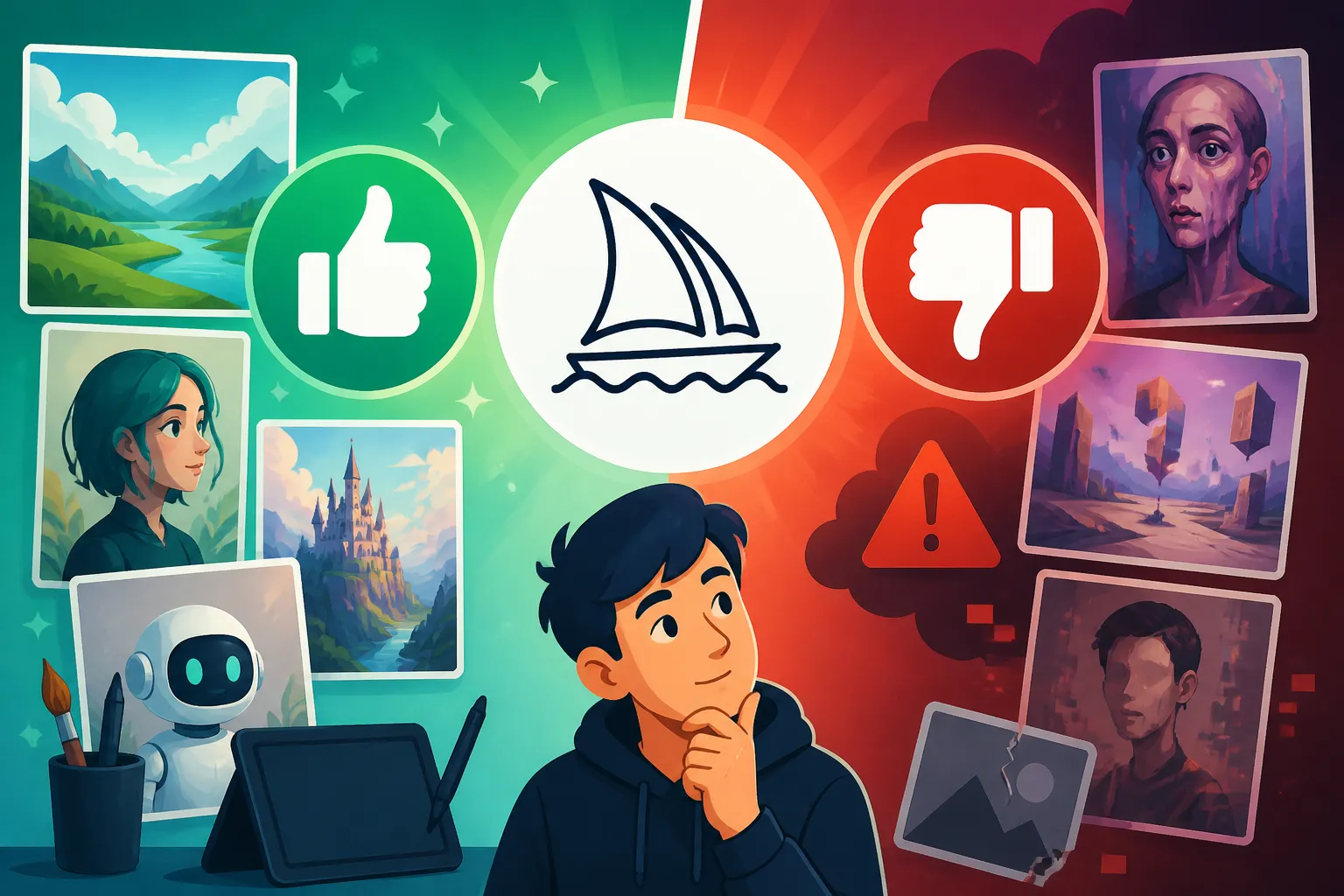
Midjourney Pros and Cons Summary
To give you a quick overview, here's a table summarizing the main points we've covered regarding Midjourney for creators:
| Aspect | Pros (Advantages) | Cons (Disadvantages) |
|---|---|---|
| Quality | High aesthetic appeal, artistic and detailed output, distinct style, often photorealistic | Occasional uncanny valleys, hands/faces can be distorted, minor artifacts |
| Speed | Rapid concept generation, quick iteration of ideas, ideal for mood boards and exploration | Time-consuming prompt engineering, post-processing often required to perfect |
| Accessibility | Democratizes high-quality visuals, low barrier to entry for non-artists, enables small businesses | Requires internet access, not fully open-source for local installation, reliance on platform |
| Control | Broad stylistic control via prompts, aspect ratio adjustments | Limited precise control over specific elements, character consistency issues, unpredictable outputs |
| Cost | Value for powerful generation capabilities, various subscription tiers | Can be expensive for heavy users, fast GPU hours deplete quickly, ongoing subscription cost |
| Ethics/Legal | Commercial rights (with paid plans), transparent terms of service | Ethical concerns over training data, potential for inadvertent copyright infringement, evolving legal landscape |
Is Midjourney Worth the Investment for Your Creative Work?
Ultimately, deciding whether Midjourney is the right tool for your creative arsenal depends heavily on your specific needs, workflow, and tolerance for its particular quirks. For creators who prioritize speed, high-quality aesthetic output, and are comfortable with a degree of artistic unpredictability, Midjourney can be an absolutely transformative tool. It excels at brainstorming, generating unique visual concepts, and adding a touch of artistic flair to projects that might otherwise feel generic. This is why many consider checking out Midjourney V7 Features and Updates to see the continuous improvements.
However, if your work demands absolute pixel-perfect precision, consistent character design across multiple frames, or if you're uncomfortable with the ethical ambiguities surrounding AI-generated art, then Midjourney might serve best as a supplementary tool rather than your primary creative engine. It requires a willingness to learn a new way of "thinking" visually through prompts, and an acceptance that a perfect result often comes after numerous iterations and possibly further refinement in traditional editing software. Whether it's Midjourney V7 vs V6: What Improved or any future iteration, the core balance of power and unpredictability will likely remain. For many, the pros often outweigh the cons, making it an invaluable asset that, when used strategically, can significantly enhance productivity and creative output.
Disclaimer
The information provided in this article is for general informational purposes only and does not constitute professional advice. The landscape of AI technology, its capabilities, pricing, and legal implications is rapidly evolving. Always refer to Midjourney's official terms of service and consult with legal or industry professionals for specific guidance related to copyright, commercial use, and any other concerns.